Category: Universal Life Insurance

The Rogue Agent goes to the archives!
  • Permanent Life Insurance: Definition, Pros and Cons

    If you put a gun to my head and asked me whether or not it made sense to buy permanent life insurance, I’d probly say “yes”.

    That’s the short answer.

    The slightly longer answer is “Probably yes for most people, but it really depends.” There will always be outliers where it doesn’t make sense for one reason or another.

    But if you’re looking at normative cases, there’s a ton of value in permanent life insurance, but only when you understand how it works, why it works the way it does, its strengths and its weaknesses and shortcomings.

    If we’re talking about a healthy, 35 year old with a great diet, who exercises 5+ days a week in some capacity, gets regular checkups, has no health problems, who has a relatively clean driving record and no overtly risky hobbies, has a family and makes a decent income, and has a need/want for conservative (AKA “safe money”) savings, then I would say “yes, absolutely”. If we’re talking about a broke-and-single 70 year-old overweight couch potato smoker with a family history of heart disease, and no aspirations to leave any money to charity, then the answer is a solid “no.”

    I realize there’s a wide gulf between the above two personas, so allow me to elaborate on what, exactly, permanent life insurance is and the pros and cons of buying it so you can decide for yourself where you fit on the continuum.

    What is permanent life insurance?

    Permanent life insurance is a type of life insurance policy that’s designed to be held—wait for it—permanently. As in, for your entire life. The most basic permanent life insurance policy is called “whole life insurance”. A more complex variation of permanent life insurance is “universal life insurance”.

    Both types of permanent life insurance can build cash value, which represents the current value of the policy’s death benefit, though not all universal life policies build cash value (confusing, I know).

    How does permanent life insurance work?

    It’s very simple:

    1. Premiums are paid to the life insurance company.
    2. Expenses are deducted from the current premium + any existing cash value to support the death benefit and operations of the company.
    3. The remainder is credited with interest.

    Aaaaaaaaaand, that’s it.

    As long as the policy has cash value, the policy stays in force. If the cash value ever drops to $0, the policy lapses (terminates).

    Everything else is (kinda-sorta) a dog and pony show.

    Now, there are some quirks and nuances built into some life insurance policies. For example, Guaranteed Universal Life (GUL) is a type of universal life insurance that doesn’t build cash value. Instead, the insurance company keeps whatever cash value the policy would have generated, builds a capital reserve for the policy, and guarantees the death benefit regardless of what happens to the implied cash value. Even if the cash value would have gone to $0, the insurance company keeps the policy in force for you as long as all required premiums are paid on time.

    Whole life insurance and most forms of universal life insurance build cash value you can either withdraw or borrow against (sort of like a home equity line of credit). The borrowing function of permanent life insurance adds some amount complexity to the policy, but not much.

    The loan works like a standard line of credit (LOC), except that interest accrues daily on the outstanding principal amount and payments made on policy loans throughout the year go to reduce the principal of the loan first before interest is paid.

    In some cases, the interest credits for the policy are matched to the interest on loans, effectively canceling each other out. In other cases, there’s a small spread in either direction, resulting in a net low-cost loan or loan arbitrage.

    Permanent life insurance vs. term life insurance

    The major difference between permanent life insurance and term life insurance is the cash value and premiums used to support the policy in a permanent policy. Since term life insurance has no cash value, and is designed to be in force for a much shorter period of time, it has much lower premium payments. The premiums are used to support the policy in a more direct way. Missed premiums on term insurance will cause the policy to lapse. Missed payments on permanent life insurance won’t necessarily cause the policy to lapse because most policies include either an automatic premium loan option (APL), which will use the existing cash value to make the premium payment (whole life), or the policy automatically has expenses deducted from the cash value (UL). Permanent life insurance policies also have other important and substantial long-term benefits that term policies don’t.

    Kinda makes sense if you think about it. You get less from term insurance, so you pay less. Whole life insurance has higher premiums, but you get a lot more value from the policy.

    Cost of permanent life insurance vs term life insurance

    What policyholders tend to like about term life insurance is the fact that you can temporarily buy lots of death benefit from the insurance company for a very low premium. A $1 million 30-year term life policy on a 45 year old male, non-smoker, with a standard risk rating might have a premium of $3,308.69/yr (Source: Banner Life Insurance Company, valid as of April 2024).

    The same $1 million of whole life insurance might have a premium of $23,430/yr (Guardian Life Insurance Company of America, whole life 121, valid as of April 2024) or $18,550 (Penn Mutual Life Insurance Company, valid April 2024).

    Even on the lower end of things, the whole life premium is 5.6 times higher than the term premium. Easy to see why a lot of people choose term insurance.

    However, to get at the true cost of the whole life insurance, you need to strip out the cash value from the policy, and see what portion of the premium is going to support the cost of the death benefit. With term insurance, this is theoretically simple to understand. A lot of the premium (if not all) should be going to support the death benefit. It doesn’t work exactly this way in practice, but it’s close enough.

    With whole life insurance, you have to employ a little bit of algebra to get at the answer, but it can be done. I go into more detail about the cost of whole life and term insurance, and how to calculate the true costs of both, in my other post titled, The Cost Of Whole Life Insurance Vs. Buy Term And Invest The Difference.

    Types of permanent life insurance policies

    There are essentially 5 different types of permanent life insurance being sold in the U.S. today:

    1. Whole life insurance
    2. Current assumption universal life insurance
    3. Guaranteed universal life insurance
    4. Variable universal life insurance
    5. Indexed universal life insurance

    Whole life insurance

    Whole life has 3 things that other permanent policies don’t have:

    1. Guaranteed level premiums
    2. Guaranteed cash values
    3. Guaranteed death benefit

    These guarantees create a very stable life insurance structure, and in fact gives whole life a structural advantage over other forms of permanent life insurance. There are no assumptions about what the policy will do.

    Participating policies (dividend-paying) also include the option for higher cash values and death benefits from non-guaranteed dividend payments. Each year, the insurance company will determine how much it can afford to pay policyholders back as a dividend. The amount can (and does) change each year, and depends entirely on the company’s annual performance. Once the dividend is paid, the policyholder can choose to receive the amount in cash, keep it on account with the insurance company, use it to reduce the premium payment, or use it to buy additional paid-up life insurance. If the dividend is used to buy paid-up life insurance, it becomes part of the guaranteed cash value and can’t be lost.

    Whole life is a staple product that has traditionally performed well over long periods of time. It’s also a perennial bestseller for the large old mutual life insurers.

    Current assumption universal life insurance

    Current assumption ULs (CAUL) were very popular during the 1980s. Agents took advantage of the low rates of the 1970s by replacing underperforming whole life policies (mostly non-participating) with universal life policies paying double-digit crediting rates.

    When I first started in the life insurance biz back in 2004, I serviced a lot of these older UL policies and saw many of the assumptions made when the policy was sold. Back then, there was an old saying, “Pay three and you’re free” or “Pay for, and no more”. Meaning, the interest credits of the UL policy were supposed to be so high, you could make 3 or 4 annual premiums and then quit forever.

    It didn’t work.

    Reason being, universal life is entirely driven by assumptions, with what I’d call “technical guarantees” backing up the policy. ULs do have a minimum guaranteed crediting rate, and maximum guaranteed policy charges, but there’s no guaranteed net cash value or death benefit. And, when you throttle the policy to hit the minimum crediting rate and maximum charges, it nearly always causes the policy to crash and burn.

    Guaranteed universal life insurance (GUL)

    GUL was created in response to the failure of CAUL to deliver on its initial soft promise of a higher performing permanent life insurance policy. A lot of the older current assumption ULs lapsed due to interest rates (and thus policy crediting rates) falling in the 1990s and early 2000s. Lots of policyholders got that infamous letter in the mail telling them they’d need to either lower the death benefit of their policy or… dramatically increase their premium payments. In some cases, they were told they had to do both or the policy would lapse.

    Naturally, policyholders were a teeny tiny bit upset about that.

    And so… life insurers came up with the brilliant idea of a guaranteed death benefit UL policy.

    The catch?

    There’s no cash value component (or if there are cash values, they’re minimal).

    GULs have a level guaranteed death benefit and guaranteed level premiums. As long as the premiums are paid on time, the policy stays in force and is guaranteed to never lapse. If premiums are paid too early or too late, it can negatively affect the no-lapse guarantee provision. Sometimes, it destroys the guarantee.

    On paper, GUL solved the problem of losing a death benefit due to lapse. All the sudden, interest rates and cash values didn’t matter.

    Variable universal life insurance

    Variable universal life (VUL) was created on the back of current assumption UL, and was geared towards policyholders who still wanted an accumulation-driven life insurance policy, but without being tied to falling interest rates. The idea being, if policyholders couldn’t get policy performance from high yielding bonds, they could get it from the stock market instead.

    VUL allows policyholders to allocate their cash value to “subaccounts”, which look, feel, and act just like standard equity mutual funds, except they exist only inside a life insurance policy. Owning mutual funds inside an insurance wrapper allows policyholders to tie the performance of their policy to the stock market, which works well when the stock market is doing well and not so well when the stock market crashes.

    VUL worked well in the 1990s when the market was on a seemingly never-ending bull run. Then, it kinda fell out of favor in the late ’90s and early 2000s. It saw a mild resurgence after 2008, and seems to be seeing somewhat of a revival today.

    Indexed universal life insurance

    Indexed universal life was created on the back of the variable ULs of the 90s.

    This type of UL promises “upside potential without downside risk”—a perfect antidote for the late 90s and early 2000s (and especially 2008). Policyholders receive interest credits based on the upward movement of a stock market index, without having to invest directly in the index.

    Magic?

    Not really. Insurers take the premiums and invest them in high quality bonds. Then, siphon some of the interest off the bonds to buy index call options on the S&P 500 or some other popular equity index. The insurer uses call spreads—buying an “at the money” (ATM) call option and simultaneously selling a slightly “out of the money” (OTM) call option—to support a cap rate (or participation rate) for the policy. In some cases, there’s no cap. Instead, the insurer uses a spread (fee) to support “uncapped” index growth.

    Whatever the case, the cap/par rate is the maximum amount of money the insurer can credit to the policyholder’s cash value account. For uncapped indexing, the insurer subtracts the fee before crediting the remainder to the policyholder’s cash value.

    If the strategy flops, then the policyholder gets a big fat goose egg, but doesn’t lose money (not from the index, anyway). This is the “downside protection” of the policy. Cost of insurance (COI) and other policy charges are still deducted, though. So, it’s possible to have a zero credit year and still lose money due to charges coming out. In fact, this situation is almost inevitable at some point.

    Understanding the cash value of permanent life insurance

    Thanks to financial gurus spreading their confusions via social media, there’s a huge misunderstanding about what the cash value of a permanent life insurance policy is.

    Cash value is the net present value of the future death benefit. In other words, it’s what the death benefit is worth, right now. And, in the future, that cash value will equal the death benefit, which is called “endowment”.

    Imagine buying some item at a discount, and in the future it will be worth more. This is what the cash value is relative to the death benefit.

    That’s all it is.

    Over the years, there’s been lots of confusion about whether the insurance company steals your cash value when you die. This is nonsensical gibberish. The cash value is money set aside to pay for the future death benefit. The death benefit itself is really a combination of current cash value and pure insurance (the difference between the cash value and death benefit is called “net amount at risk”).

    There’s nothing for the insurance company to “steal”. You get exactly what the insurance company promises in the contract.

    Advantages and disadvantages of permanent life insurance

    Advantages

    • Guaranteed level premiums (whole life insurance and guaranteed universal life insurance)
    • Guaranteed lifetime death benefit (whole life insurance and guaranteed universal life insurance)
    • Guaranteed cash value growth (whole life insurance)
    • Return on cash value similar to high-quality bond fund
    • Whole life dividends can significantly add to the guaranteed rate; universal life crediting rates, caps, and participation rates might increase substantially—you might earn significantly more than originally illustrated
    • Liquidity similar to money market fund
    • Option to invest in equities (variable life insurance)
    • Upside potential with downside risk protection (indexed universal life)
    • Tax-free buildup inside the policy
    • Tax-deferred or tax-free access to cash values via partial surrenders and policy loans—Borrow against the cash value of the policy for major expenses
    • Policy loans are tax-free, generally low-cost, and offset by interest credits from the issuing insurance company
    • Option for accelerated death benefits riders
    • Premiums waived when disabled (with disability waiver of premium rider)
    • Option to buy additional paid-up life insurance without underwriting (whole life insurance)
    • Option to transfer who is insured under the policy (certain whole life and universal life policies)
    • Optional guaranteed purchase option allows future insurance purchases without evidence of insurability
    • Ability to protect pension payments for spouse (“pension max”)
    • Cash values can be used to supplement retirement income (“LIRP”)
    • Cost of whole life insurance is lower than term insurance if held to maturity/endowment—20 and 30-year cost might be lower than term insurance if the policy is a high cash value policy
    • No volatility in cash values allows policyholders to take more risk in investments, can offset investment losses and be used to buffer volatility in investments
    • Whole life insurance is a simple and straightforward product design, structurally stable
    • Major mutual carriers that issue whole life insurance have a 100+ year history of paying dividends, and all of them have excellent financial ratings
    • Provides liquidity at death—the death benefit is immediately transferred to heirs, bypassing probate
    • Provides asset protection in some states—certain state laws prohibit creditors from taking the cash value and death benefit to satisfy a debt
    • Can avoid estate taxes if placed in an irrevocable life insurance trust (ILIT)
    • Can provide financial security for a disabled dependent if you yourself will never be financially independent
    • Can be used to fund “key man” insurance plans, executive bonus plans, and buy-sell agreements

    Disadvantages

    • More complex than term life insurance
    • Higher premiums than term insurance
    • High fixed expenses in the early years of the policy (retail whole life and universal life)
    • Can be more expensive than term if the policy lapses in the early years
    • Limited liquidity in the first 3-7 years of most policies—you might not “break even” until years 7-15
    • No “wiggle room” in premium payments
    • Expected returns are lower than equities
    • Policy loan interest compounds annually if not paid, and can eventually cause the policy to lapse
    • Policy loans and withdrawals might negatively affect the policy’s death benefits—unpaid policy loans reduce the net death benefit paid to beneficiaries at death
    • Some supplemental term riders added to whole life and universal life policies can potentially become prohibitively expensive to the point of causing negative returns on cash value over the long-term
    • Policies can potentially become a modified endowment contract (MEC) if too much premium is paid in any given year or significant material changes are made to the policy via changes to the death benefit, partial surrenders, or policy loans
    • Mutual insurance companies can demutualize and nuke the dividend; stock companies can sell off unprofitable lines of business to another company that will lower crediting rates and raise policy expenses
    • Universal life insurance has built-in “levers” allowing the insurance company to increase expenses and decrease crediting rates
    • Mutual insurers can lower dividends based on negative company performance—you might get far less than what was originally illustrated

    When should you buy permanent life insurance?

    Until or unless medical science gives you complete control over biological aging, assume you’re going to die at some point. That being the case, life insurance can be appropriate for anyone at any age. But, not everyone values the coverage, and that’s what it really boils down to. If you have lots of assets, and you want to protect and transfer those assets in a simple and tax-advantaged way, permanent life insurance is the simplest way to do it.

    Some will argue the step-up in basis at death makes permanent life insurance policies unnecessary but, as with any tax favors, the IRS can and does change the rules. Rev. Rul. 2023-2 now disallows the step-up in basis at death when assets are placed into an irrevocable trust. To get the step-up basis, assets must be in a person’s taxable estate.

    Of course, this opens them up to estate (and other) taxes. Of course, if a person’s estate is small, it might not be a big deal. But this also assumes you won’t be liquidating those assets before death and that your heirs won’t want to liquidate them either.

    Plenty of times when a parent has left a house to their kids, for example, and they want nothing to do with it—they just want to sell it. They’ll pay a bunch of taxes on it. If you care enough to leave them something, the life insurance can either pay the taxes for them or eliminate the burden of taxes altogether for liquid assets if using an irrevocable life insurance trust.

    Either way, permanent life insurance is a simple way to pass wealth onto the next generation, while still benefiting from it (in the form of cash value) while you’re still alive.

  • The Cost Of Whole Life Insurance Vs. Buy Term And Invest The Difference [With Complete Commission and Fee Breakdown]

    It feels like the cost of whole life insurance vs buy term and invest the difference debate has been done to death, but… look over the landscape.

    What’s missing?

    A complete breakdown of the actual costs of both strategies over a long period of time. By “cost”, I mean the total costs associated with mortality and expense, not just commissions paid to agents, fees paid to financial advisors, or worse… a perfunctory glance at the difference in premiums. Premiums do not represent just costs. Premiums include amounts set aside for cash reserves (even for term insurance) and, sometimes, they can hide certain costs. This makes some options appear better (or worse) than they really are.

    OK, let’s get into it.

    Summary: Cost Of Whole Life Insurance vs. Term Insurance Costs + Investment Fees

    Summary: Cost Of Whole Life Insurance

    • Policyholder: 45 yr-old male, standard, non-smoker
    • Policy: $1 million whole life
    • Premium: $18,179/yr
    • 76-year total net cost: $2,765,390.50
    • 30-year total net cost: $209,092.16
    • Commissions paid to life insurance agents (included in total costs): Between $17,815.42 and $28,453.52, depending on the commission structure for the insurance agent

    I found the lifetime cost of a whole life policy (76 years in this analysis) was $2,765,390.50. This includes a calculation of the full mortality and expense charges of the policy, which includes commissions paid to the life insurance agent.

    I also looked at a more narrow, “real world”, scenario where a policyholder chooses between buying a whole life policy and paying premiums for 30 years versus buying a 30-year level term and investing the difference for the same period of time.

    Let’s be real. This is what most people will do.

    Mortality and expense (M&E) charges for 30 years totaled $209,092.16, before adjusting for M&E credits. Commissions paid to the insurance agent (which are included in M&E) totaled between $17,815.42 and $28,453.52, depending on the commission structure for the insurance agent. Life insurance agents get paid different amounts, based on their contract with the issuing life insurer or their general agent. In general, new life insurance agents get paid less than seasoned insurance agents.

    Summary: Cost Of Term Life Insurance + Investment Fees

    • Policyholder: 45 yr-old male, standard, non-smoker
    • Policy: $1 million term life
    • Premium: $3,309/yr, investing the remaining $14,870.12
    • 76-year total cost: Between $5,093,306.09 and $10,450,740.64, depending on the rate of return earned and the fees charged
    • 30-year total cost: Between $186,274.92 and $307,113.01
    • Commissions and fees paid to life insurance agents and advisors (included in total costs): Between $89,324.73 and $213,107.73

    I shopped multiple insurance companies and found the total lifetime costs (76 years) for term and investing fees to be between $5,093,306.09 and $10,450,740.64, depending on the rate of return earned and the fees charged, a significant sum compared to the whole life policy.

    The cost for term and the fees paid to a plan administrator or financial planner for a buy term and invest the difference plan over the same 30 years ranged between $186,274.92 and $307,113.01. The large discrepancy is the result of the large difference in both assumed rate of return and the fee structures of financial planners. Higher rates of return result in more investment management fees being paid on larger account balances.

    Total commissions paid to the life insurance agent + investment fees (which will be slightly lower than the total premiums + investment management fees) were between $89,324.73 and $213,107.73.

    Although this analysis showed whole life was mostly (but not always) cheaper than an equivalent buy term, invest the difference strategy, this doesn’t necessarily mean a whole life policy is better than investing or buying a term policy, as I’ll explain later. But as far as cost is concerned, whole life tends to be cheaper in every instance except when a 4% return assumption is used and taxes are excluded from the cost analysis.

    Basic Assumptions And Limitations Of This Analysis

    What’s an analysis without assumptions?

    Every analysis has to make some basic assumptions. Problem is, the way these kinds of analyses are usually done leaves much to be desired. 

    Here’s what I mean: usually, life insurance agents and financial planners will explain the costs of whole life policies in simplistic terms—quoting the premiums for each. Since whole life premiums are always higher than term premiums, the assumption is the cost for a whole life policy must be higher.

    This is a non-sequitur.

    Premiums for whole life are higher than for term because a large portion of the premium must be set aside for the cash value of the policy. A term policy has no cash value. This is why “invest the difference” looks at investing the money saved by not buying a whole life policy.

    If you want a good sense for how much each strategy costs, look at the total costs for both strategies over a long period of time. “Cost” means embedded costs in the policy, which includes not just commissions paid to the life insurance agent but also the actual mortality and other policy expenses (i.e. M&E).

    This is not nearly as easy to do as a perfunctory glance at the premiums, but it’s far more accurate.

    For whole life, I reverse engineer the mortality and expense charges of the policy using the known premium, cash value, and compounding rate (i.e. the dividend rate)—a little trick I learned from my fellow insurance agent, Brian Fechtel. I then isolate and add back in the mortality and expense credits from the insurance company. 

    For buy term and invest the difference, I look at the term premium and commissions earned, plus the investment fees associated with investing in a tax-favored investment account, which includes fees you will typically find inside a 401(k) or other retirement plan as well as fees a financial planner might charge you to manage your investments. The calculation of these fees is based on the latest research available from the Investment Company Institute, 401(k) Averages Book, 23rd Edition, and data compiled by AdvisoryHQ.

    I compiled the data, and did this analysis, so you could get an idea of how pricing for life insurance and investments work, and get a sense for the relative costs of each. This is not meant to be financial, tax, legal, or insurance advice. Just an informational analysis. All life insurance numbers (i.e. tabular values, illustrations) were obtained using quoting software commonly available to licensed life insurance agents, so the numbers are accurate insofar as the illustrations go. 

    Even so, there are some limitations to this kind of analysis. Here are the big ones:

    • This analysis looks at only one age, gender, risk rating, and policy type. Policy type and design by the life insurance agent can affect a policy’s internal costs. It also assumes the dividend rate for whole life remains level.
    • In my almost 20 years of doing this, I’ve never seen dividend rates stay flat. They will vary greatly depending on the bond holdings of the company, current interest rates, profitability from supplemental lines of business, and several factors that are outside the scope of this analysis. Even in a falling rate environment, I’ve seen insurers raise dividends. So… a flat dividend rate is unlikely to occur for decades at a time. In a rising interest rate environment, dividend rates do tend to rise. In a falling rate environment, dividend rates do tend to fall. Though, dividends can and do fluctuate up and down contra interest rates. This will affect the overall costs of a whole life policy. Cost of insurance is also highly sensitive to age, gender, and risk rating, so it’s very possible a different age, gender, or risk rating will show radically different results. For example, coverage for a 45 year old (both term and whole life) will be more expensive than for younger ages. Likewise, the cost for coverage would be higher for older ages. Also, males pay more (sometimes, substantiallymore) than females, which would alter the results (possibly significantly). If dividend rates rise from the initial projected rate, it can reduce the illustrated costs of the policy. The reverse is also true. Finally, a preferred, or better, rating will dramatically reduce the cost of insurance (especially for whole life).
    • In this analysis, I used a flat-fee assumption for investment fees, which understates the fees charged for investment management, particularly for professionally-managed investments. In reality, fees are higher (sometimes substantially higher) for smaller portfolio amounts, with fees increasing and decreasing at various portfolio sizes. I assumed a lower overall fee structure rather than using different fees at various portfolio sizes.
    • Commissions can vary greatly depending on the actual commission structure of the agent, the insurance company, and the product itself. This won’t affect the total costs of the policy shown in this analysis (since commissions are inclusive of the total M&E), but a different commission rate might make the commissions look higher or lower than illustrated in this analysis. For example, one insurance company might pay life insurance agents a lower or higher commission than another, even for the same product. The insurance company might have different “tiers” or grid systems it uses to pay insurance agents based on personal production or sales performance.
    • Taxes are not included in this cost analysis. Taxes will tend to increase the cost of the buy term and invest the different strategy only if or when the investment is “cashed out” and spent. In contrast, a whole life policy offers a couple of different options to use the cash value but avoid taxes. Since this analysis did not include a “spend down” of the investment or cash value, these costs were omitted.

    Life Insurance Policy + Investment Assumptions

    Here are some basic assumptions I made when assembling the insurance quotes and investment data:

    • Insurance is on a male, age 45, standard, non-smoker buying a $1 million life insurance policy. For the whole life illustration, I use a term blend and paid-up additions rider to fund the policy with the required premium.
    • I shopped multiple companies for term quotes using CompuLife®, a trusted quoting service/software that many agents use. I also obtained term quotes from the major mutual carriers, including Penn Mutual, MassMutual, and The Guardian. For whole life, I compared quotes and prepared illustrations from MassMutual, The Guardian, and Penn Mutual.
    • Unless otherwise stated, all premiums are paid annually and all investment contributions are received at the beginning of the year, in full.
    • Commissions are based on a percentage of annual premiums paid rather than a payment grid or any of the other commission structures available to agents.
    • Investment assumptions for “buy term and invest the difference” use a 4%, 6%, and 8% compounding rate. 
    • Investment fees will be based on data obtained from the 2022 Investment Company Institute report on 401(k) fees and the 23rd edition of the 401(k) Averages Book. For self-managed tax-advantaged retirement accounts, I assume the average “all in” (mutual fund + admin) fee for large plans equal to 0.88% of account assets annually. For professionally-managed investments, I assume a median expense ratio of 0.33% and a 1.02% AUM fee.
    • This analysis will show the full cost for carrying term to maximum insurable age (94), as well as costs for investing to age 121 to match the whole life policy illustration. Most people who buy term and invest the difference will purchase (at most) a 30 year term insurance policy, then drop the term, so I also show the costs associated with this scenario.

    How Much Life Insurance Costs

    Let’s get this out of the way first.

    The cost of insurance always increases over time, regardless of the type of policy you buy. Older = higher risk of death, and thus, higher mortality costs which translates into a higher premium for the coverage.

    All policies are built on the 1-year annually renewable/yearly renewable term life chassis. This means when you buy a 1-year renewable policy, you pay the premium for one year’s worth of insurance. The following year, the insurer renews your policy at a new rate that reflects your new (older) age and you pay the premium for that year’s worth of coverage. Each year you renew your policy, the premium (and cost) of the policy increases until you get mad and quit.

    The only real difference between level term and whole life is how the insurance company chooses to levelize the premium, and what other benefits or bells and whistles the company wants to add to the policy. Policies with lots of benefits have a higher premium than policies with fewer benefits.

    Annual Cost For An Annually-Renewable Term Policy

    Here’s what the annual costs look like for an annually-renewable (also called “yearly renewable”) term insurance policy (45 yr-old male, std, non-smoker):

    Graph showing annually- renewable term life insurance costs

    Annual costs for annually-renewable term insurance for a 45 year-old male, std rating, non-smoker. Premium starts at $1,530 in year 1, and climbs to $335,240 in year 50, with a maximum guaranteed annual premium of $485,080. Total cumulative premiums for 30 years equals $655,790. Cumulative total lifetime premiums are $4,092,260

    For this particular policy, the first year non-guaranteed premium is $1,530. The premium rises each year until the 50th year, when the annual premium is $335,240. However, the annual premiums could be much higher. If the current assumptions change, the 50th-year guaranteed premium could be $485,080.

    Cumulative Costs For An Annually-Renewable Term Policy

    Cumulative costs for this annually-renewable policy over 30 years is $655,790. The cumulative lifetime total cost over 50 years is $4,092,260, but these premiums could be higher under the guaranteed assumptions, up to $5,930,610.

    Costs For 30-Year Level Term + Annually Renewable Policy

    Many (but not all) people drop their term policy after 30 years because the cost skyrockets. But to give a true “apples to apples” comparison, I looked at the total costs for term. Even 30-year level term gets expensive after a while (click image to enlarge).

    Graph showing 30-year level term, then switching to annually- renewable term life insurance once the level premium period ends.

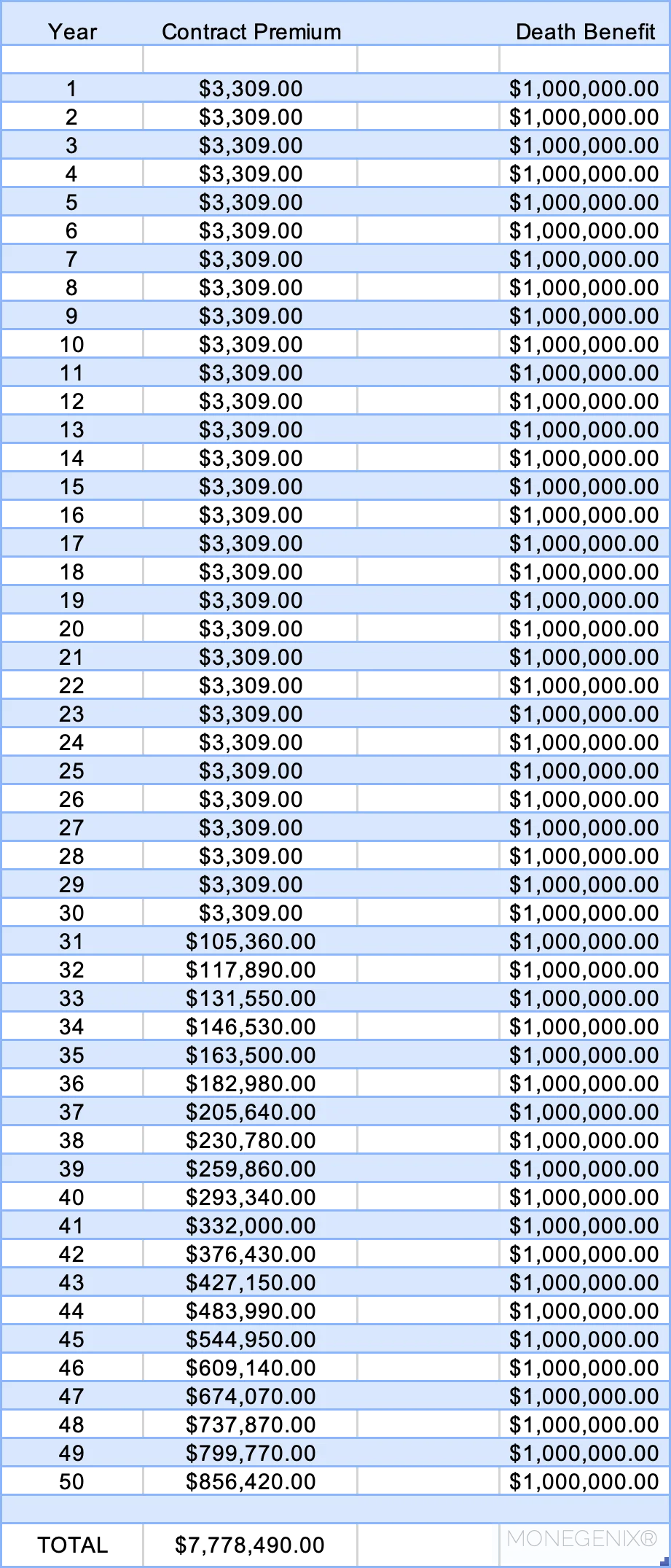
    Annual costs for 30-year level term insurance, then switching to annually-renewable term insurance once the level premium period ends. The costs for this policy for a 45 year-old male, std rating, non-smoker is $99,270 over the first 30 years. Cumulative total costs over 50 years is $7,778,490.

    30 year term cost, plus yearly renewable term to maximum insurable age.

    30-year term life insurance cost, plus yearly renewable term out to maximum insurable age of 95 (50 years). Total term cost is $7,778,490.

    Total costs for 30-year level, then yearly renewal thereafter is $7.7 million. 

    If that sounds like a lot of money, it’s because it is. Even a 30-year level term policy with renewal options is going to be expensive. In fact, the 30-year level policy is more expensive than the regular yearly-renewable policy. 

    Why?

    Many life insurers break even or lose money on the level premium period in anticipation of policyholders renewing at the (much) higher yearly-renewable rate. Contrary to popular opinion, not everyone drops their policy after 30 years. Insurers have found a significant percentage of policyholders keep paying the increasing cost of the term policy… enough that it’s worth it to sell the policy at a loss or break even for the first 30 years. The company simply makes their profit on the back end of the policy when premiums skyrocket.

    All other things being equal, the lifetime cost for $1 million of life insurance for a 45 year old male (standard rating) should be between $4 million and $6 million, regardless of the policy type you’re buying. This is why life insurers levelize premiums and use their general investment account to “flatten” or “hold down” the rising cost of insurance for policyholders. Trying to pay for the pure cost of insurance each year is insanity.

    Levelized premium payments allow the insurance company to collect more than the cost of insurance in the early years of the policy. The higher premium paid in the early years of the policy is invested, and a portion of the investment earnings is used to pay for the rising insurance costs. In essence, the insurance company overcharges the policyholder in the early years of the policy so they can undercharge them later. 

    This is true of all level term policies, universal life, and whole life policies sold in the U.S., with the primary difference being how much more the insurer collects from the policyholder to invest.

    With term, the insurer collects just a little bit more, and keeps any overage that’s left over when the policy expires.

    With universal life and whole life, the insurer returns the excess to the policyholder through the cash value of the policy. Something else happens in a whole life policy and some forms of universal life, too. The cash value of the policy becomes the reserve used to pay for the future death benefit, so the pure insurance component of the policy is reduced as cash value increases. This reduction in the pure insurance amount effectively lowers the total cost of insurance, especially over very long periods of time.

    Whole Life Insurance Commissions

    Yay! Everyone’s favorite topic.

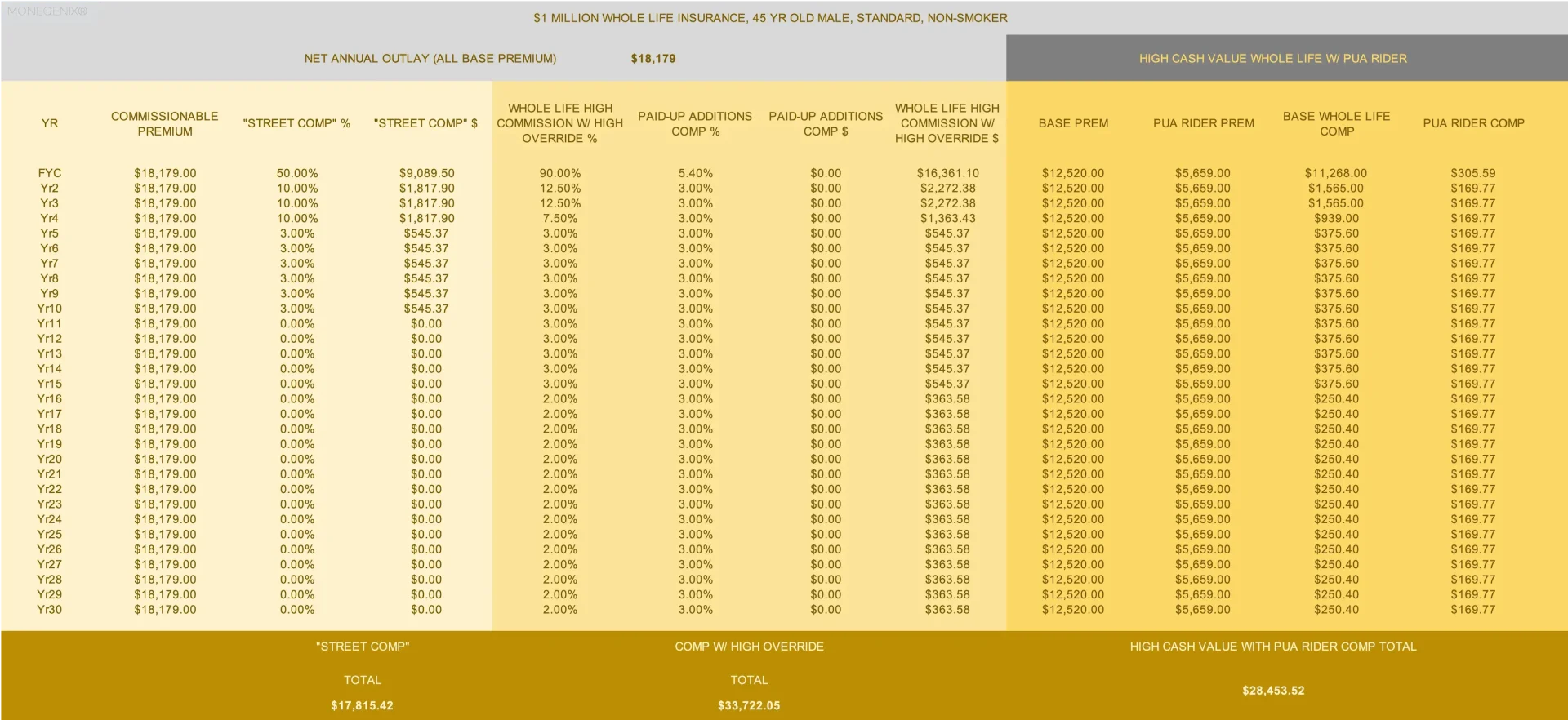
    Here’s the breakdown on how much life insurance agents get paid on whole life (click image to enlarge):

    Whole life insurance commission tables

    Whole life commissions depend on the agent’s compensation plan. Agents are paid based on a percentage of the base premium collected from the policyholder, plus excess over the base, typically from supplemental policy riders, including supplemental term riders and paid-up additional insurance riders. “Street comp” can be very low, but ultimately depends on the broker’s contract with a general agent or insurance company. Base commission rates are typically in the 50-55% range for first-year commissions, with compensation dropping dramatically in subsequent years. This is called “heaped commission”, and is common throughout the industry.

    Whole life is sold by either a captive or independent agent. However, most whole life is sold by captive agents (though, some independent agents do get direct appointments with insurers or work through general agents to get access to whole life carriers). 

    Life insurance agents typically earn a commission based on the first year premium amount as well as premiums paid in subsequent years. The exact commission earned will depend on the agent’s compensation plan. 

    A captive agent will work exclusively for one insurance company, and will have compensation tied into his salary, which might include other company benefits, like a retirement plan, disability coverage, and other benefits. An independent agent, however, typically doesn’t get company benefits since they don’t work directly for an insurer. Instead, the independent agent might represent multiple different insurance agencies, and receives compensation from either the insurer directly or from a general agent associated with the insurer. The compensation may only include basic “street comp”, or it might include “street comp” plus an override (additional money paid to the agent to offset marketing and other costs).

    Regardless, both types of agents sell insurance on commission.

    A captive agent might earn more or less than an independent agent, depending on the policy, and whether the insurance carrier bases the commission off of a target premium, a special payment grid, or as a percentage of the base premium + overrides.

    This commission structure assumes commissions are paid based on a percentage of the first year’s premium, plus overrides and renewal commissions in years 2+

    However, notice the first year commission (FYC) is much higher than in subsequent years. This is called a “heaped” commission. The commission percentage in the first year is high, then drops off for the renewal commissions earned in years 2+.

    The total commissions paid to the life insurance agent over 30 years might vary between $17,815.42 for insurance agents earning “street comp” (the lowest commission tier) and $33,722.05 for insurance agents earning a high override on all base premiums.

    Annual And Total Lifetime Costs For A Whole Life Policy (Cumulative M&E)

    Summary Of Costs

    • 76-year (gross) cost: $2,858,129.50
    • 76-year (net) cost: $2,765,390.50
    • 30-year (gross) cost: $229,391.16
    • 30-year (net) cost: $209,092.16

    Annual M&E is laid out in the following chart (click image to enlarge):

    Annual cost of whole life insurance graphic

    Annual cost for whole life insurance rises each year, just like term insurance. Unlike term, however, levelizing the premium allows the insurer to “hold down” these rising costs to the policyholder.

    See how expenses start high, then fall, then rise again into the stratosphere? This is the normal trajectory for these costs, which is why levelizing premiums and doing a good job managing the general investment account at the insurer is so important.

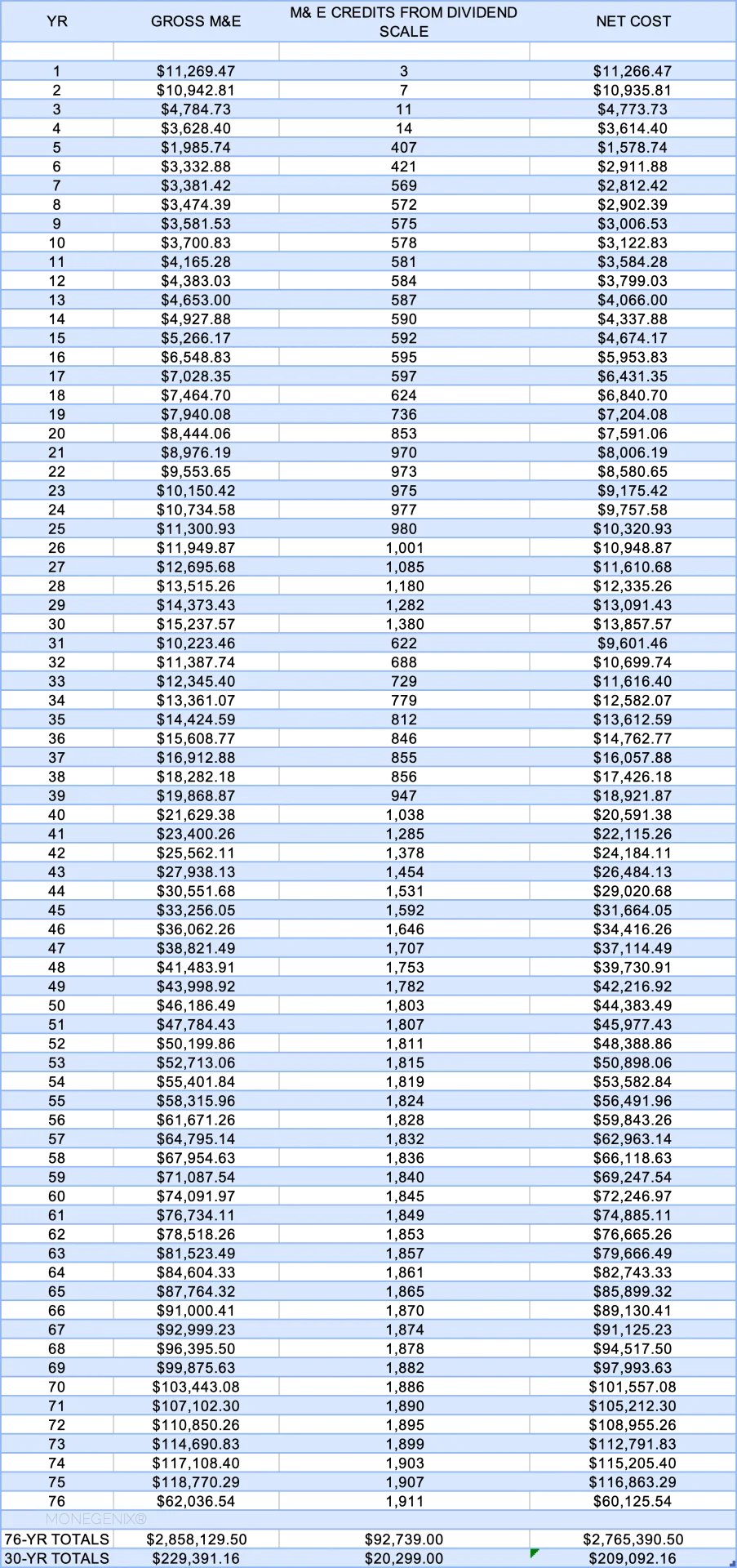
    Here is a breakdown of the annual costs by the numbers, as well as the lifetime and 30-year totals (click image to enlarge):

    Total cost of whole life insurance over 76 years is displayed in tabular format.

    Estimated mortality and expense of this policy was reverse engineered by subtracting the policy’s compounding rate from the end-of-year cash value totals, then subtracting out the prior year’s cash value and premium, leaving the M&E. Interest credits were then added back in based on the policy’s dividend attributable to M&E credits. Total net lifetime costs for whole life insurance is $2,765,390.50. The 30-year net cost of whole life insurance is $209,092.16. This is far less than an equivalent term insurance policy + investment fees.

    Mortality and expenses for this policy were calculated based on the following formula:

    Annual Illustrated Costs = (Prior Year-End Cash-Value + Current Premium Paid) – (Current Year-End Cash-Value / (1 + Illustration’s Compounding Rate))

    This formula essentially reverse engineers the internal costs of the policy. Then, dividend credits were added back in.

    Why were dividend credits added back in?

    Well, virtually all whole life insurance dividends incorporate 3 factors.

    The 3-Factor Dividend Model

    1. Morality savings
    2. Expense savings
    3. Investment gain

    The column titled “M&E credits from dividend scale” refers to the portion of the annual dividend that represents mortality and expense savings (Factors #1, and #2). I was able to strip out the investment component of the dividend scale using the insurer’s illustration software and show only the part of the dividend representing M&E credits. These credits are essentially a refund of expenses to the policyholder, which lowers the cost of insurance.

    The first year’s cost is fairly close to the first year’s premium. This is to be expected since the first few years expenses are very large. The capital reserve must be established, plus insurance agent commissions paid, and so on. Although I don’t discuss cash value growth in this analysis, I do want to mention here that these costs are irrespective of the cash value buildup. Some policies with this cost structure have little to no cash value buildup in the first year, while others have high first-year cash surrender value. This particular policy had high early-year cash values.

    BUY TERM AND INVEST THE DIFFERENCE 30-year and TOTAL COSTS

    LIFETIME COSTS FOR TERM LIFE INSURANCE + INVESTMENTS

    Summary Of Costs

    • 76-year cost: Between $5,093,306.09 and $10,450,740.64, depending on the rate of return earned and the fees charged
    • 30-year cost: Between $186,274.92 and $307,113.01
    • Commissions and fees paid to life insurance agents and advisors: Between $89,324.73 and $213,107.73

    For term policies, this is relatively straightforward. The cost is the premium. The insurance agent earns a commission on the sale of term insurance, which is a percentage of the premium. The following illustration shows the “all in” costs for 76 years (a lifetime for a 45 year old) of term plus the fees for investing at various growth rates and fee/AUM percentages. 

    The first 30 years of the term policy are level premium years. After the level premium period is over, the policy automatically switches to yearly-renewable, which tops out after 50 years, and terminates (the policyholder is no longer insurable). The investment fees continue for the rest of the policyholder’s life to age 121.

    This long time period was used to match the whole life policy illustration (click image to enlarge).

    A graphical representation of the 76-year cost of term life insurance plus investment management fees.

    The 76-year cost of term insurance, plus investment management, grows each year. There’s a substantial drop in annual costs when the term policy terminates at the maximum insurable age of 95.

    30-Year Cost For Term Insurance + Investments

    Many (but not all) policyholders cancel their 30-year term once the level premium period ends, so it’s helpful to see what those costs look like, too. The above graph shows how the cost remains somewhat modest for the first 30 years, then explodes upwards. The following tabular illustration shows the combined 30-year cost and 76-year cost for term life insurance plus the fees for a hypothetical investment at various growth rates and fee/AUM percentages. The 30-year cumulative total cost is between $186,278.52 and $307,116.61 and depends on the assumed growth rate and fees charged for the investment management.

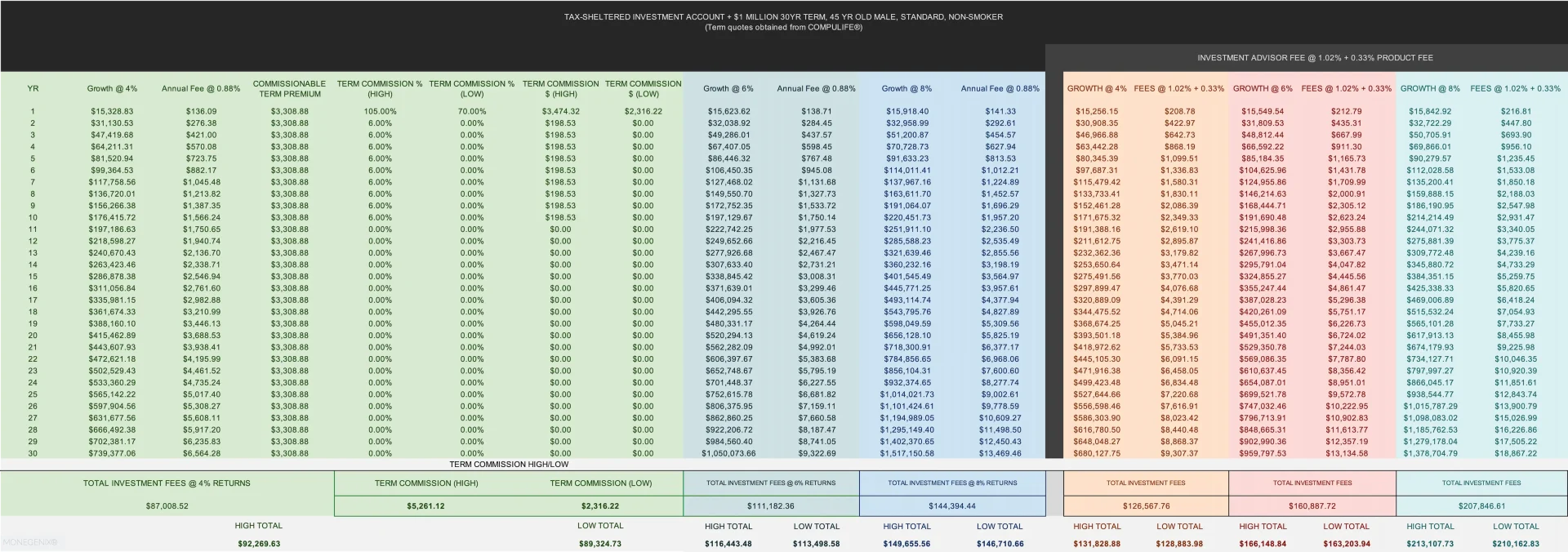
    30-Year And Lifetime Total Costs For Term Life Insurance And Investment Fees

    (click image to enlarge)

    Illustration showing lifetime costs for term life insurance plus investment management.

    The 76-year cost of term life insurance (30-year term, plus yearly renewable thereafter), plus investment management fees is between $8.7 million and $14.1 million. 30-year cost is between $186,278.52 and $307,116.61 and depends on the assumed growth rate and fees charged for investment management.

    Term Commissions And Investment Management Fees Paid To Life Insurance Agents And Financial Advisors

    A common belief is that commissions on term life insurance and investment management fees are not just less, but much less, than commissions paid on a whole life policy. It is also assumed the high commission rates paid on whole life negatively influence the advice given to clients, with the conclusion being clients should always (or mostly) be advised to buy low-cost term insurance and “invest the difference”. 

    The basis for this recommendation largely hinges on the cost argument.

    This believe is so widespread, few even question it, much less investigate the origin of this claim. The following illustration shows the 30-year cumulative cost for term insurance and investment management, assuming different growth rates and fee structures (click image to enlarge).

    An illustration/tabular values showing commissions paid on term life insurance and investment management for 30 years.

    Commissions for term life insurance and investment management for 30 years are between $89,324.73 and $213,107.73. Exact fees and commissions depend on the growth rate assumed on the investment, plus investment management fee structure. Commission rates for term insurance also vary, but less so than investment fees.

    Commissions were calculated using a standard BGA (Broker General Agent) contract. Fees were determined using the latest research and data from the Investment Company Institute, 401(k) Averages Book (23rd Edition), and data compiled by AdvisoryHQ.

    Commissions and fees vary, but are substantial, even on the low end. In most cases, the cost of whole life insurance is lower than the cost for an equivalent “buy term, invest the difference” strategy for a 45-year old male. Younger ages result in even lower costs for all types of life insurance. Investment management fees are not impacted by age, but rather by duration of the investment (time horizon) and the size of the portfolio.

    Assuming the national average “all in” fee (0.88%) for tax-qualified investment accounts (which includes a low-cost mutual fund), fees for “buy term and invest the difference” should be roughly $90,000 over 30 years.

    The investment fees alone were roughly $87,000 on the low end, with term insurance commissions ranging between $2,316 and $5,261.

    Final Thoughts About The Cost Of Life Insurance vs Investing

    Life insurance and investing serve two different purposes.

    Even within the life insurance product category, different types of life insurance serve different purposes. Some life insurance agents like to say that life insurance only serves one purpose: to protect those you leave behind.

    This is a convenient narrative to sell term policies, which is fine. That’s what term is for—to protect those you leave behind. It’s simple life insurance. That’s just what it is.

    But permanent life insurance serves different purposes. For example, a whole life policy can be set up to provide a death benefit, supplemental savings (via the cash value of the policy), a dedicated line of credit you own and control (via the cash value of the policy), disability benefits, chronic, critical, and terminal illness benefits (i.e. an advancement of the death benefit for various permanent illnesses), and even long-term care insurance (which is similar to health insurance, except that it explicitly pays for long-term care, and other related, expenses which are not covered by normal health insurance policies).

    Basically, permanent insurance can be set up to protect you from a variety of different financial risks instead of just one. And since the policy is permanent, it lasts your entire life and cannot be taken away from you.

    The cost of life insurance coverage for both is high, but understandably so. Providing an insurance guarantee in the event of death costs money—a lot of money. 

    Regardless, investments cannot replicate this function. 

    Likewise, investments serve an important wealth-building function. They cannot replace life insurance, but life insurance also cannot replace investments. Ideally, your policies should protect your income and savings, and give you a solid foundation to build wealth. Your investments should augment your wealth-building ability, whether that’s an investment in a business you own or someone else’s business (i.e. stocks), or some other investment altogether (bonds, real estate, gold, etc.).

    Insurance agents and financial planners (and really, the entire insurance industry) would be better off figuring out how to incorporate investments and life insurance in the same financial plan, rather than pitting one against the other. For decades, both the investment and insurance industry have spent valuable resources tearing each other down. 

    Investment advisors and financial planners accuse both captive agents and independent agents of selling life insurance products (particularly whole life insurance) that are harmful to consumers. Insurance agents, meanwhile, accuse investment advisors of misleading clients about the returns possible with more speculative investments, and potentially losing their client’s money when an investment goes sideways.

    Life insurance companies seem to straddle this issue, by owning both traditional life insurance businesses, and brokerage firms, each simultaneously publishing “hit pieces” about the other side of the business.

    Honestly, none of this is necessary.

    A big part of this battle has been over the costs associated with each strategy. While I did not cover every possible iteration of investing, term, and whole life insurance here, there’s enough information here for you to understand the general principle and relative cost of each strategy. 

    While life insurance products tend to be very expensive over the long-term, whole life is, surprisingly, cheaper in the majority of cases compared to a “buy term and invest the difference” strategy. That doesn’t mean you shouldn’t invest your money. It means if you want to use life insurance as a “shield” for your investments, or if there are other reasons you want to remain insured for your entire life, then whole life insurance is (by far) the lower-cost option compared to term.

    Of course, cost alone is not the sole reason to buy or avoid a particular financial product or to adopt or avoid a particular financial strategy. It’s merely one piece of the puzzle.