Author: David Lewis

The Rogue Agent goes to the archives!
  • In the rebellion against whole life insurance, count me as part of The Empire

    A long time ago, on a website far, far, away, a group of financial planners and rebel insurance agents decided to form a clever-sounding movement called, “The Whole Life Insurance Rebellion”

    The Rebel Leader of the movement has stated his mission is to “educate” (AKA expose) whole life insurance as an expensive and mostly crappy financial product.

    He even has a nifty quote on his website from the gooroo of finance himself, Dave Ramsey:

    “Cash value life insurance is one of the worst financial products available.”

    Fast forward to today…

    I’m on the founder’s email list.

    He sends me periodic emails about his marketing and lead generation course for insurance agents.

    Below is a transcript of an email exchange I had with him:

    ***

    Rebel Leader: As I write this email on Thursday night (set to go out Friday morning), one of my agents just hit a $51,394 premium Protective case (the lead came from my site, [website]) that went in force a couple days ago.

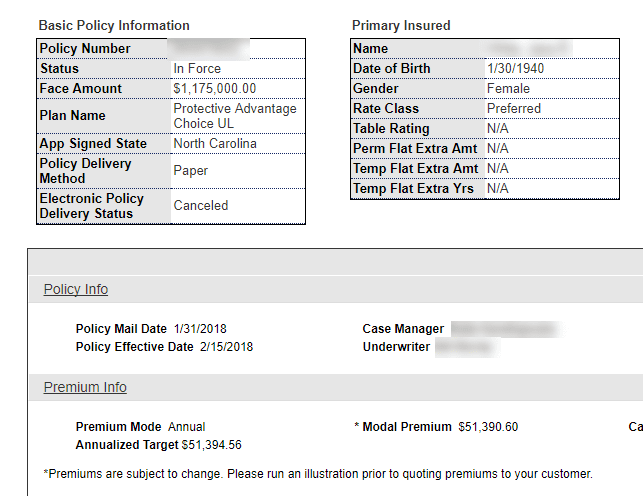
    Check it out:

    Agent commission for universal life insurance

    This universal life policy has an annualized target of $51,394.56. Target premiums determine commissions paid to agents. At a 100% comp rate, this agent would make $51,394.56, while simultaneously chastising other agents for selling “high commission” whole life insurance. UL policies of this type generally do not offer increasing death benefits, so policyholders experience declining returns on death benefit payouts over time.

    The Rebel Leader who sold this policy goes on to say:

    Best part is I never even spoke to the client. I’ll split that commission with my agent and make over $20k and I didn’t even lift a finger. Imagine that.

    Indeed. Imagine that. Now, that’s what I call customer service. You take their money and they don’t even get to talk to you.

    The plot thickens…

    Me: Does that card say 1980 as the client’s birth date?

    ***

    Rebel Leader: 1940. We’d have to sell about a 20 million dollar policy to a 38 year old to get that sort of premium. lol

    ***

    Me: That’s too funny.

    Nice commission though. I’ve never made anywhere near that much for similar sized whole life policies but… I’ve also never tried selling permanent insurance to a 78 year old.

    ***

    Rebel Leader: It was a slam dunk estate planning case. She’s 78. Has tons of disposable income and money sitting around in CD’s and bonds making next to nothing, and that she doesn’t need. If she lives another 15 years even, she’ll have put in around 765k and her estate receives over 1.1 Million. Not a bad return. If she dies earlier the return is even better!

    Her CPA loved it!

    ***

    How amusing.

    I can’t say I’m surprised.

    At the end of the day, even the Whole Life Insurance Rebels sell permanent life insurance with biiiiiiiiiiiig commissionzzzzzzz.

    More:

    The policy type in the image above that the Rebel Leader’s agent sold to his client is a type of universal life insurance. This policy type tends to pay out a higher commission than whole life.

    Based on information from my UL carriers, some carriers pay less in commissions than whole life but… almost all of the carriers I’ve seen over the years pay somewhere between 10% to 25% more in total commissions to agents. Policies with no cash value build-up can sometimes pay significantly higher commission.

    Not that that’s bad in and of itself but… one of the Rebel Leader’s main arguments against whole life insurance is the high cost and fat commissions paid to agents.

    Moving on.

    At the risk of openly siding with “The Empire,” the way I sees it is… if you’re going to end up owning a permanent life insurance policy when you’re 78 years old and the cost of insurance is high, then you might as well buy it when you’re 38 years old, healthy, and the cost of insurance is low.

    No agent, no matter how skilled, can predict how a 38 year-old’s life is going to shake out and… quite a lot of people do end up buying whole life or universal life insurance at some point.

    And… sales of permanent insurance aren’t limited to wealthy individuals either. Most people buy permanent insurance late in life to offset the cost of a funeral and burial costs. They can’t afford to buy more than what they need for final expenses so… they buy smaller policies.

    Wealthier individuals buy permanent insurance for estate planning purposes.

    And then you have youngish folks between age 35 and 50 who buy whole life insurance for its cash value buildup as well as for estate planning…

    Either way, the sooner you buy it, the cheaper (and better) it is.

    More:

    It strikes me as a little Darth Vaderish to talk about your client’s death as a good rate of return and… to exclaim she’ll get an even higher return if she dies sooner rather than later.

    But, that’s my totally biased opinion as someone who designs custom high cash value whole life insurance plans that you don’t have to die to use or benefit from.

    Don’t get me wrong. The death benefit absolutely is a return on your premium dollars and it absolutely serves an important purpose but… I’d be hard pressed to sell “rate of return” as a primary benefit to the insured policyholder who must die for that return to materialize.

    Anywho, if you want more info on how my custom insurance plans can help you protect your income, savings, and your business or family while you’re still alive and kicking… then join my email list.

  • The problem with blended whole life insurance

    There’s a right way and a wrong way to own a blended whole life policy.

    But, before I get into that, story time.

    A long time ago, in a galaxy far, far away, I wrote about how anyone could save 50% (or more) or their take home pay. Part of the secret is in how you set up your budget (or rather, how you ditch your budget and use cash flow planning). But part of it is how you buy and set up the financial products you use in your life…from bank accounts to life insurance and even investments.

    It’s not so much what you buy though as much as it is how you use those things. Most people work way too hard. You only need to start saving between 10% and 15% to get things going. Anymore than that is like going on a crash diet (unless you’re already out of debt, in which case it might make sense to save more). Things will seem good at first, and then it will unravel and you’ll be in a worse position than before.

    There are getting to be more and more promoters of whole life insurance, for example. They tell you to plow everything into life insurance, and that all you need to do is buy it and something magical will happen. I could do that. I could sell you on that idea…make it magical. Make it seem special. Use really hype-y sales copy. Truth is, some of these people are very good marketers. But, I know from speaking to them they don’t have the backend systems in place to manage it all for their clients.

    Example: I know of a few life insurance agents really pushing the idea that you should blend whole life with term insurance and that this will allow you to “boost up” your whole life cash value. It’s true…it will. I did this with my own policy. But, there’s a huge catch. What happens is…and I learned this the hard way…what happens is…

    …the term insurance cost starts to rise over time.

    And, so, if the term blending isn’t done properly, then it doesn’t work out so well. When dividends aren’t enough to pay for the term insurance, you pay more for your insurance out of pocket. Also, with some of these setups, a lot of the flexibility in the policy is lost because the dividends must go toward converting that term insurance into permanent insurance.

    You can’t use the dividends to pay premiums…

    You can’t take dividends as cash…

    You can’t do anything with those dividends but keep paying for term insurance.

    …and…

    Taking policy loans becomes a bit more risky…

    That’s the bad news.

    It’s a shame, really. Because blended whole life insurance can be a great way to own whole life insurance. But… the way some agents do it, what’s going to happen is these clients are going to buy into a great idea, execute it poorly, and then crash and burn. The concept will still be valid, but they won’t believe it anymore because they were missing one crucial piece of the puzzle. These term riders that are added to these blended whole life policies should be convertible to whole life insurance. Instead of making the dividend pay for the cost of annually-renewable term, the term itself should automatically convert to whole life insurance with each premium payment. Not only does this reduce the risk of the thing blowing up, it makes everything else about the policy less risky over time. And, you should see a healthy bump in dividend payments as the term is converted to whole life. Much better than a kick in the pants and a bigger bill from the insurance company.

    Anyway, if you want me to guide you through the ins and outs of life insurance and how to correctly set up a blended whole life policy, then sign up to my email list and let’s rock and roll. You can also read The Perfect Policy™ to get an idea of how a good whole life policy should function and perform.

  • Life insurance myths that cost you millions

    I’ve been thinking a lot about life insurance.

    Mainly because I’ve been redoing a lot of videos, and audio, in preparation for the new Monegenix® Media app. But, also because I’ve been seeing more and more myths about life insurance floating around the web.

    Here are a few of them:

    1. You should never mix insurance and investing.
    2. Permanent life insurance is too expensive.
    3. You don’t need a middle-man for your investments, and that’s what an insurer is.
    4. Term insurance is cheap.
    5. You don’t need a lot of life insurance.
    6. You can never buy too much life insurance.
    7. Whole life has a terrible rate of return.
    8. The only ones recommending permanent insurance are the ones making a commission off it or who have a vested interest in sales.
    9. Term + investing always results in more money.
    10. Complexity favors the seller, and whole life is too complicated.
    11. Even when it works out OK, it takes too long to see positive returns.
    12. Most people lapse their permanent insurance policies.
    13. You should only expect the guaranteed minimum in your insurance policy.
    14. You don’t need insurance when you’re old.

    And the list goes on and on.

    Anyway, these myths are pervasive and…

    …if you believe them, then so be it.

    I’m not going to force you to buy whole life insurance.

    But, don’t say I didn’t warn you.

    Now, if you’re serious about understanding whole life insurance, and how it can help you build real financial security, then join my email list and start the journey.

  • Case Study: Renting vs Owning A Home

    A few years ago, I flew down to Florida for Christmas to spend time with family, and we ended up playing that game Taboo. It was boys vs girls. The word was “Nike.” The clue was “Prefontaine.” They guessed correctly. We lost.

    I was dumbfounded.

    Right then and there I made a New Year’s resolution to work on my Taboo skills.

    OK, I’m lying. I made no such resolution. But, with the new year still fresh in my mind, I thought I would revisit one of those myths in finance that just won’t die – the idea that you should always own your own home and that owning is always superior to renting.

    This year, hundreds, possibly thousands, of people are resolving to pay off their home. Many are thinking about buying a home for the first time. When it comes to business property (especially buildings and storefronts), many business owners understand the economic benefits of leasing and renting. Yet, when it comes to personal residences, they buy.

    Since a house is one of the largest personal purchases you will probably make in your lifetime, you should know what you’re getting yourself into. Seriously.

    Don’t take your financial planner’s word for it.

    Don’t take your mortgage broker’s word for it.

    Don’t take your real estate agent’s word for it.

    Don’t even take my word for it.

    For me, I don’t start to really benefit, economically, from buying a home unless I can find a nice place selling for under $350,000. Ideally, that home would cost about $300,000 or less.

    One of the “undeniable” truths you’re told is that it’s  always better to own a home than to rent an apartment.

    The logic behind this advice is that when you own a home, you are always (or  often) building equity, when you rent, all you’re only ever left with are receipts.

    But, is it true?

    There are two ways to look at it.

    When Buying A Home, And Building Equity, Is A Bad Idea

    When I lived in central New York, I was renting an apartment for $600 per month. It included gas (heat) and water/sewer. The electric was not included. Electric ran me about $80 per month. So, my total household expenses were roughly $680 between rent and basic utilities. Sure, there’s T.V., phone, and Internet, but let’s keep things simple for now.

    People used to tell me all the time that I should be buying a home – that I was losing money by renting. But, I was always curious about this idea. I didn’t really know what the market was like.

    So, I started going to a lot of open houses, I checked the local listings in the newspaper, and I spent some time driving around new housing developments.

    What I noticed was this: most of the homes in the area sold for about $100,000. Some of nicer ones went for $150,000 or $200,00, but this was somewhat unusual.

    If I purchased a home in the $100,000 range, my mortgage payment would have been about the same as my rent at the time (assuming a 6 percent interest rate on the home loan).

    However, I would have had to pay for homeowner’s insurance ($35 per month), and I would have been responsible for paying for my own natural gas/heat. What about renter’s insurance? Shouldn’t I be including the cost of renter’s insurance in my analysis when I say I’d have to buy homeowner’s insurance?

    Well, I was in my 20s – young, dumb, and without anything worth insuring, so no.

    This wasn’t a cost I was considering at the time. When you take out a massive loan for a house, though, they pretty much make you buy homeowner’s – at least basic fire coverage, so that would have been an increase in outlay for me.

    The natural gas would have cost me an additional $100 per month (based on an average of about 20-30 homes I walked through during “open house season”), and taxes on the property would have likely been $225 a month or more (taxes are really high in the Corning/Elmira area). Some of the nicer homes in the new housing developments came with a property tax bill in excess of $10,000.

    So, right out of the gate, I figured it would cost me an additional $360 every month to own a home – just in the added cost of the utilities, taxes, and homeowner’s insurance.

    That doesn’t even include mortgage interest. But, I know what you’re thinking:

    What about the equity that my house would have been building?

    For a moment, let’s assume that I took the standard deduction on my taxes instead of itemizing. If my home appreciated an average of 3-4 percent a year, that gain would have been offset by the additional $360 I would have had to pay over renting. The additional mortgage interest would put me in the red. So, I’d need an appreciation of more than 4 percent annually to make it worthwhile. In Corning/Elmira area, homes don’t really appreciate in value all that quickly. If I continued to rent, I could save and invest that $360 every month and wouldn’t have to worry about the interest on a new mortgage loan – so, I continued to rent. If you’re still doubting the benefits of renting, consider this: most people don’t take out just one mortgage on a house. Electrical wires fray, furnaces break, plumbing  leaks, roofs sag. That’s just a fact of life.

    The interest on the original mortgage alone (assuming a $100,000 home at 6 percent interest) amounts to $116,000 over the life of the  loan, or $3,866 per year (average over 30 years). Now, add in any additional interest from a second or even a third mortgage that you take out to do remodeling or repairs. When I add the $360 per month extra over renting ($4,320/yr) to the $3,800 in interest per  year, I end up with a total of roughly $8,120 a year that I have to overcome for the house to be  more profitable than renting. Even if I let my hypothetical house deteriorate over time, and do no repairs on it, my home would have had to consistently appreciate faster than 8 percent a year,  every year. That’s just not realistic.

    Now that I’m living in Raleigh Durham a much smaller town in the country, has the story changed any? Sort of.

    I used Michael Bluejay’s awesome rent vs buy calculator (which I talk about in one of my videos) to help me get a rough idea as to when it made sense to buy a home. After my son was born, what we needed was a 3 or 4 bedroom home with a finished basement or… a garage with 8-foot ceilings, minimum. Because of all the lockdowns and restrictions that happened during COVID, we wanted to build our own home gym and avoid the hassle of going to a commercial gym. We needed a 2 bedroom (minimum) home with a den or a separate room that could be used as an office for me.

    Something like that (the 4-bedroom) could run us anywhere between $65,000 in a dumpy neighborhood to $3 million for something really very amazing.

    Really, I can find something OK for about $200,000 to $350,000 in OK neighborhoods. If I were to buy, the mortgage payment would be around $1,500/month with a 5 percent interest rate. If I were to pay rent on a 4-bedroom home, it would have run me around $1,200 on average at the time I was making this decision. 

    Yes, there were $3,000 rents – but those are high-rent districts.

    According to Bluejay’s calculator, I really needed a home under $350,000 to benefit, economically. At $350,000 or more, it takes more than 30 years for buying a home to be more profitable than renting.

    Even at $325,000, it takes a good 19 years for the home purchase to pay off – and that’s assuming I earn no more than 5.5 percent on my investments (remember, I will save the money I’m not spending on mortgage interest, taxes, etc.).

    I am pretty confident in my ability to earn 5.75 to 6 percent annually over the long-term. This means that I really need a cheaper house – somewhere in the $300,000 range – for buying to become profitable.

    You want to know what’s weird? Even if buying a home eventually does start to pay off, there’s no guarantee that it will always pay off in the long-run.

    If I adjust the calculator to show what would happen if I earned 8 percent annually on my investments over the long-term, instead of 5 to 6 percent, I end up with a scenario where buying a home is a better deal than renting after 12 years – but that deal eventually turns sour on me. In year 19, renting becomes more profitable again. Ouch.

    Now, while I know my situation is unique to me, I’d wager a guess that there are many scenarios under which renting would work out to be a better deal for you too. Now, onto the qualitative side of things.

    When Buying A Home Is A Good Idea

    Buying a home can be a good idea when the qualitative factors outweigh the quantitative ones, when the quantitative factors make sense, or both. Qualitative factors include things like your own personal needs, optional objective values, and rational wants. Quantitative is numbers. So, either you have to really, really want it (in spite of whether it’s a good “investment”), the numbers have to work out so that it’s a good investment, or both.

    So, for example, I lift weights. Currently, I pay a membership to a gym. Really, it’s not that much money, and it would actually cost me a lot more to set up a proper gym in my own home.

    But, I want the ability and freedom to lift weights on my own schedule. I don’t really like the idea of waiting around for some guy who’s hogging the squat rack so he can do bicep curls (which is a universal annoyance in a public gym). It wastes my time, and that is presumably a real cost though not something I bother to sit down and calculate.

    I also would like to have a larger yard for a future child to play in. How do you quantify joy?

    I don’t know.

    Finally, I want my own garage so I can do “guy stuff” like change the oil in my car and sit around and use foul language with other guys while we eat chicken wings and drink beer. Having a garage with a rental is difficult to impossible. So, all of those things are big benefits of buying a home.

    Likewise, if I can buy a home, and it appreciates faster than what I’m paying in interest on a mortgage plus the cost of maintenance, then numbers-wise, it makes sense to buy a home.

    A Few Other Opinions

    A few other opinions and perspectives from people you may or may not be familiar with, and whose opinions you may or may not value:

    James Altucher — He’s run a hedge fund, authored numerous books, has operated I don’t know how many businesses, and is probably Superman for all I know.

    Anyway, his take on buying a home? I’ll let him tell you in his own words:

    …I’m never going to buy a home again.

    According to Altucher, they’re expensive, they leave you with no cash (and lots of debt), and they trap you in ways you never realize until after the loan docs are signed.

    Paula Pant — Paula warmed the frigid cockles of my own miserly Scrooge McDuck heart when she dared to post this article on renting vs buying a home.  She’s a professional real estate investor. Anyway, I highly recommend Paula’s “rant,” if you can call it that, because it’s highly informative and lacks the usual B.S. you see on the web about this topic.

    Giovanni Isaksen — Isaksen owns a successful real estate investment company. Like other professionals in the industry, his business depends on understanding these kinds of analyses. And, he spent a lot of time breaking down the numbers. In fact, he threw down the gauntlet when Zillow published its now-famous study which concluded that buying a home was awesome.

    What Isaksen brings to the table is a keen eye on what things really cost in real estate. According to the analysis:

    …previous calculation ignored the real costs of maintenance, repairs and saving up for replacing big expensive things like the roof, the furnace and the driveway and that is a pretty big chunk of money over time. Industry figures for repairs and maintenance on single family housing run from one to three percent of the home value.

    Underestimating costs isn’t new. Investors do this all the time.

    All. The. Time.

    But, you’d never figure a respectable site like Zillow would do it. But, they did.

    Anywho, if you read the full analysis, you’ll see some stuff in there that you will not see anywhere else (including my blog).

    So…Why Do Real Estate Investors Own Homes?

    I know what you’re thinking: But David, real estate investors own homes!

    You’re right. They do. And, here’s why: Because it can be an excellent (and profitable) business.

    They also use lots and lots of leverage.

    Paying off a home isn’t necessarily the goal. Making rental income is.

    So… it’s profitable because they are basically lending the house to renters and using the bank’s money to make a very high return on investment.

    But, if all you want to do is live in your home, then you’re (probably) going to be disappointed by the ROI (especially if your goal is to pay with cash or pay off the home and live in it “free and clear”).

    Yes, a you can use leverage (a mortgage) to get a good return (on paper) on buying a home to live in… but you have to sell the home (and buy another) to realize that profit… and really… a house is something you buy because you don’t want to deal with your landlord’s B.S. anymore or maybe you just want to paint the walls puce without getting permission first, and you’re willing to pay a premium for that benefit.


  • Karen doesn’t like whole life insurance

    A little while back, I stumbled into the graveyard of YouTube, where a bunch of “Karen” videos lie. 

    Basically, a bunch of amusing videos of “Karens” flipping out over inane things like yard signs, people moving furniture into their homes, and neighbors having the “wrong” flags flying in front of their homes. 

    There were even some soy boy male “Karens”…

    Anyway, the reason I bring all this up is because it seems like “Karens” are everywhere these days. 

    … getting offended by nearly any little thing. 

    … feeling entitled to your time, money, and even…

    … feel compelled to tell you how you *should* live your life. 

    Example:

    One time I got a series of comments (from the same person) on one of my YouTube videos about whole life insurance that went like this:

    “Your cash value should never commingle with your life insurance… Cash value is a fraud… See Dave Ramsey…. he will let know that this is BS.”

    In fact, there were so many comments on that video by the same person, left in rapid succession… it sort of seemed like the person was having a full blown panic attack, right there on YouTube.

    It was a great opportunity for me to link to some of my other videos (for the benefit of others in the comment’s section, obviously).

    Another one of my favorites is this:

    “My friends/family/co-workers think I’m crazy for buying whole life insurance instead of doing [insert traditional investment].”

    My response to that sort of comment?

    “If you like your retirement plan, you can keep your retirement plan!”

    I’m not a politician making promises I don’t intend to keep, nor am I telling you what to do with your money. 

    Also… if a person is that worried about what others think, then they probably have no business doing something so “outside the box” as buying whole life insurance. Seriously, this is outside the box type of planning, and it creates a lot of stress and anxiety in people who are conformists or people who can’t think for themselves. 

    And since a lot of conformists today are driven mostly by feels, it probably “makes sense” to them to simply follow the crowd instead of doing something that requires independent thought.

    Look, the only thing I do here is insure and safeguard people’s savings with life insurance (and teach them how to use their policy to grow and protect their business and their wealth).

    But only if they really value that sort of thing.

    Anyway… if that sort of thing appeals to you, and you’re ready to learn more about how this stuff really works, then go download the free Monegenix® Labs app, and start listening to and watching all the free life insurance videos and trainings.