Author: David Lewis

The Rogue Agent goes to the archives!
  • Permanent Life Insurance: Definition, Pros and Cons

    If you put a gun to my head and asked me whether or not it made sense to buy permanent life insurance, I’d probly say “yes”.

    That’s the short answer.

    The slightly longer answer is “Probably yes for most people, but it really depends.” There will always be outliers where it doesn’t make sense for one reason or another.

    But if you’re looking at normative cases, there’s a ton of value in permanent life insurance, but only when you understand how it works, why it works the way it does, its strengths and its weaknesses and shortcomings.

    If we’re talking about a healthy, 35 year old with a great diet, who exercises 5+ days a week in some capacity, gets regular checkups, has no health problems, who has a relatively clean driving record and no overtly risky hobbies, has a family and makes a decent income, and has a need/want for conservative (AKA “safe money”) savings, then I would say “yes, absolutely”. If we’re talking about a broke-and-single 70 year-old overweight couch potato smoker with a family history of heart disease, and no aspirations to leave any money to charity, then the answer is a solid “no.”

    I realize there’s a wide gulf between the above two personas, so allow me to elaborate on what, exactly, permanent life insurance is and the pros and cons of buying it so you can decide for yourself where you fit on the continuum.

    What is permanent life insurance?

    Permanent life insurance is a type of life insurance policy that’s designed to be held—wait for it—permanently. As in, for your entire life. The most basic permanent life insurance policy is called “whole life insurance”. A more complex variation of permanent life insurance is “universal life insurance”.

    Both types of permanent life insurance can build cash value, which represents the current value of the policy’s death benefit, though not all universal life policies build cash value (confusing, I know).

    How does permanent life insurance work?

    It’s very simple:

    1. Premiums are paid to the life insurance company.
    2. Expenses are deducted from the current premium + any existing cash value to support the death benefit and operations of the company.
    3. The remainder is credited with interest.

    Aaaaaaaaaand, that’s it.

    As long as the policy has cash value, the policy stays in force. If the cash value ever drops to $0, the policy lapses (terminates).

    Everything else is (kinda-sorta) a dog and pony show.

    Now, there are some quirks and nuances built into some life insurance policies. For example, Guaranteed Universal Life (GUL) is a type of universal life insurance that doesn’t build cash value. Instead, the insurance company keeps whatever cash value the policy would have generated, builds a capital reserve for the policy, and guarantees the death benefit regardless of what happens to the implied cash value. Even if the cash value would have gone to $0, the insurance company keeps the policy in force for you as long as all required premiums are paid on time.

    Whole life insurance and most forms of universal life insurance build cash value you can either withdraw or borrow against (sort of like a home equity line of credit). The borrowing function of permanent life insurance adds some amount complexity to the policy, but not much.

    The loan works like a standard line of credit (LOC), except that interest accrues daily on the outstanding principal amount and payments made on policy loans throughout the year go to reduce the principal of the loan first before interest is paid.

    In some cases, the interest credits for the policy are matched to the interest on loans, effectively canceling each other out. In other cases, there’s a small spread in either direction, resulting in a net low-cost loan or loan arbitrage.

    Permanent life insurance vs. term life insurance

    The major difference between permanent life insurance and term life insurance is the cash value and premiums used to support the policy in a permanent policy. Since term life insurance has no cash value, and is designed to be in force for a much shorter period of time, it has much lower premium payments. The premiums are used to support the policy in a more direct way. Missed premiums on term insurance will cause the policy to lapse. Missed payments on permanent life insurance won’t necessarily cause the policy to lapse because most policies include either an automatic premium loan option (APL), which will use the existing cash value to make the premium payment (whole life), or the policy automatically has expenses deducted from the cash value (UL). Permanent life insurance policies also have other important and substantial long-term benefits that term policies don’t.

    Kinda makes sense if you think about it. You get less from term insurance, so you pay less. Whole life insurance has higher premiums, but you get a lot more value from the policy.

    Cost of permanent life insurance vs term life insurance

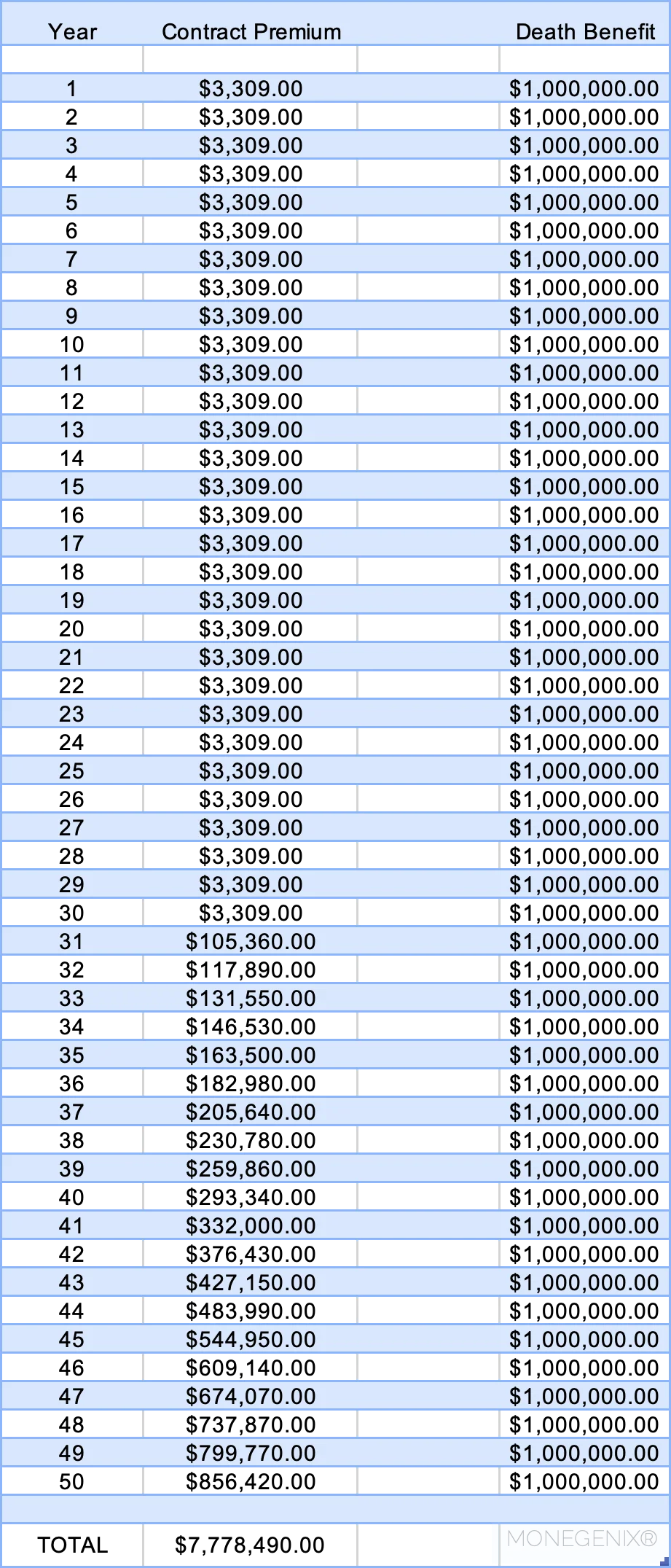
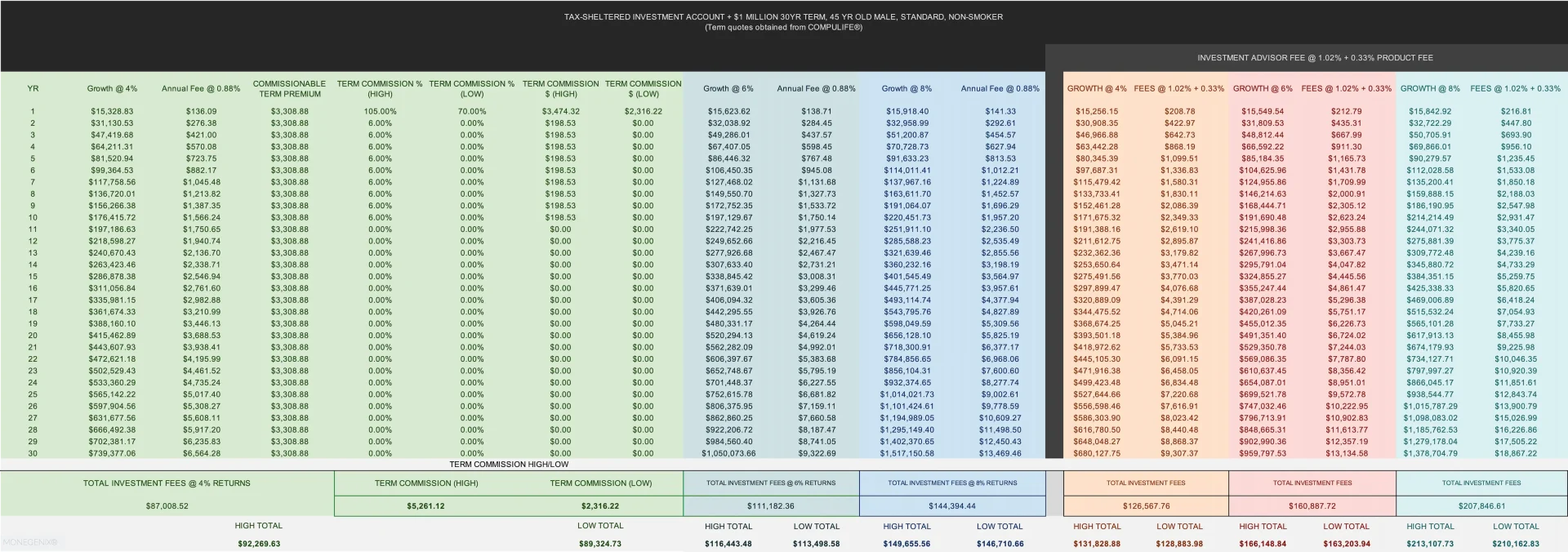
    What policyholders tend to like about term life insurance is the fact that you can temporarily buy lots of death benefit from the insurance company for a very low premium. A $1 million 30-year term life policy on a 45 year old male, non-smoker, with a standard risk rating might have a premium of $3,308.69/yr (Source: Banner Life Insurance Company, valid as of April 2024).

    The same $1 million of whole life insurance might have a premium of $23,430/yr (Guardian Life Insurance Company of America, whole life 121, valid as of April 2024) or $18,550 (Penn Mutual Life Insurance Company, valid April 2024).

    Even on the lower end of things, the whole life premium is 5.6 times higher than the term premium. Easy to see why a lot of people choose term insurance.

    However, to get at the true cost of the whole life insurance, you need to strip out the cash value from the policy, and see what portion of the premium is going to support the cost of the death benefit. With term insurance, this is theoretically simple to understand. A lot of the premium (if not all) should be going to support the death benefit. It doesn’t work exactly this way in practice, but it’s close enough.

    With whole life insurance, you have to employ a little bit of algebra to get at the answer, but it can be done. I go into more detail about the cost of whole life and term insurance, and how to calculate the true costs of both, in my other post titled, The Cost Of Whole Life Insurance Vs. Buy Term And Invest The Difference.

    Types of permanent life insurance policies

    There are essentially 5 different types of permanent life insurance being sold in the U.S. today:

    1. Whole life insurance
    2. Current assumption universal life insurance
    3. Guaranteed universal life insurance
    4. Variable universal life insurance
    5. Indexed universal life insurance

    Whole life insurance

    Whole life has 3 things that other permanent policies don’t have:

    1. Guaranteed level premiums
    2. Guaranteed cash values
    3. Guaranteed death benefit

    These guarantees create a very stable life insurance structure, and in fact gives whole life a structural advantage over other forms of permanent life insurance. There are no assumptions about what the policy will do.

    Participating policies (dividend-paying) also include the option for higher cash values and death benefits from non-guaranteed dividend payments. Each year, the insurance company will determine how much it can afford to pay policyholders back as a dividend. The amount can (and does) change each year, and depends entirely on the company’s annual performance. Once the dividend is paid, the policyholder can choose to receive the amount in cash, keep it on account with the insurance company, use it to reduce the premium payment, or use it to buy additional paid-up life insurance. If the dividend is used to buy paid-up life insurance, it becomes part of the guaranteed cash value and can’t be lost.

    Whole life is a staple product that has traditionally performed well over long periods of time. It’s also a perennial bestseller for the large old mutual life insurers.

    Current assumption universal life insurance

    Current assumption ULs (CAUL) were very popular during the 1980s. Agents took advantage of the low rates of the 1970s by replacing underperforming whole life policies (mostly non-participating) with universal life policies paying double-digit crediting rates.

    When I first started in the life insurance biz back in 2004, I serviced a lot of these older UL policies and saw many of the assumptions made when the policy was sold. Back then, there was an old saying, “Pay three and you’re free” or “Pay for, and no more”. Meaning, the interest credits of the UL policy were supposed to be so high, you could make 3 or 4 annual premiums and then quit forever.

    It didn’t work.

    Reason being, universal life is entirely driven by assumptions, with what I’d call “technical guarantees” backing up the policy. ULs do have a minimum guaranteed crediting rate, and maximum guaranteed policy charges, but there’s no guaranteed net cash value or death benefit. And, when you throttle the policy to hit the minimum crediting rate and maximum charges, it nearly always causes the policy to crash and burn.

    Guaranteed universal life insurance (GUL)

    GUL was created in response to the failure of CAUL to deliver on its initial soft promise of a higher performing permanent life insurance policy. A lot of the older current assumption ULs lapsed due to interest rates (and thus policy crediting rates) falling in the 1990s and early 2000s. Lots of policyholders got that infamous letter in the mail telling them they’d need to either lower the death benefit of their policy or… dramatically increase their premium payments. In some cases, they were told they had to do both or the policy would lapse.

    Naturally, policyholders were a teeny tiny bit upset about that.

    And so… life insurers came up with the brilliant idea of a guaranteed death benefit UL policy.

    The catch?

    There’s no cash value component (or if there are cash values, they’re minimal).

    GULs have a level guaranteed death benefit and guaranteed level premiums. As long as the premiums are paid on time, the policy stays in force and is guaranteed to never lapse. If premiums are paid too early or too late, it can negatively affect the no-lapse guarantee provision. Sometimes, it destroys the guarantee.

    On paper, GUL solved the problem of losing a death benefit due to lapse. All the sudden, interest rates and cash values didn’t matter.

    Variable universal life insurance

    Variable universal life (VUL) was created on the back of current assumption UL, and was geared towards policyholders who still wanted an accumulation-driven life insurance policy, but without being tied to falling interest rates. The idea being, if policyholders couldn’t get policy performance from high yielding bonds, they could get it from the stock market instead.

    VUL allows policyholders to allocate their cash value to “subaccounts”, which look, feel, and act just like standard equity mutual funds, except they exist only inside a life insurance policy. Owning mutual funds inside an insurance wrapper allows policyholders to tie the performance of their policy to the stock market, which works well when the stock market is doing well and not so well when the stock market crashes.

    VUL worked well in the 1990s when the market was on a seemingly never-ending bull run. Then, it kinda fell out of favor in the late ’90s and early 2000s. It saw a mild resurgence after 2008, and seems to be seeing somewhat of a revival today.

    Indexed universal life insurance

    Indexed universal life was created on the back of the variable ULs of the 90s.

    This type of UL promises “upside potential without downside risk”—a perfect antidote for the late 90s and early 2000s (and especially 2008). Policyholders receive interest credits based on the upward movement of a stock market index, without having to invest directly in the index.

    Magic?

    Not really. Insurers take the premiums and invest them in high quality bonds. Then, siphon some of the interest off the bonds to buy index call options on the S&P 500 or some other popular equity index. The insurer uses call spreads—buying an “at the money” (ATM) call option and simultaneously selling a slightly “out of the money” (OTM) call option—to support a cap rate (or participation rate) for the policy. In some cases, there’s no cap. Instead, the insurer uses a spread (fee) to support “uncapped” index growth.

    Whatever the case, the cap/par rate is the maximum amount of money the insurer can credit to the policyholder’s cash value account. For uncapped indexing, the insurer subtracts the fee before crediting the remainder to the policyholder’s cash value.

    If the strategy flops, then the policyholder gets a big fat goose egg, but doesn’t lose money (not from the index, anyway). This is the “downside protection” of the policy. Cost of insurance (COI) and other policy charges are still deducted, though. So, it’s possible to have a zero credit year and still lose money due to charges coming out. In fact, this situation is almost inevitable at some point.

    Understanding the cash value of permanent life insurance

    Thanks to financial gurus spreading their confusions via social media, there’s a huge misunderstanding about what the cash value of a permanent life insurance policy is.

    Cash value is the net present value of the future death benefit. In other words, it’s what the death benefit is worth, right now. And, in the future, that cash value will equal the death benefit, which is called “endowment”.

    Imagine buying some item at a discount, and in the future it will be worth more. This is what the cash value is relative to the death benefit.

    That’s all it is.

    Over the years, there’s been lots of confusion about whether the insurance company steals your cash value when you die. This is nonsensical gibberish. The cash value is money set aside to pay for the future death benefit. The death benefit itself is really a combination of current cash value and pure insurance (the difference between the cash value and death benefit is called “net amount at risk”).

    There’s nothing for the insurance company to “steal”. You get exactly what the insurance company promises in the contract.

    Advantages and disadvantages of permanent life insurance

    Advantages

    • Guaranteed level premiums (whole life insurance and guaranteed universal life insurance)
    • Guaranteed lifetime death benefit (whole life insurance and guaranteed universal life insurance)
    • Guaranteed cash value growth (whole life insurance)
    • Return on cash value similar to high-quality bond fund
    • Whole life dividends can significantly add to the guaranteed rate; universal life crediting rates, caps, and participation rates might increase substantially—you might earn significantly more than originally illustrated
    • Liquidity similar to money market fund
    • Option to invest in equities (variable life insurance)
    • Upside potential with downside risk protection (indexed universal life)
    • Tax-free buildup inside the policy
    • Tax-deferred or tax-free access to cash values via partial surrenders and policy loans—Borrow against the cash value of the policy for major expenses
    • Policy loans are tax-free, generally low-cost, and offset by interest credits from the issuing insurance company
    • Option for accelerated death benefits riders
    • Premiums waived when disabled (with disability waiver of premium rider)
    • Option to buy additional paid-up life insurance without underwriting (whole life insurance)
    • Option to transfer who is insured under the policy (certain whole life and universal life policies)
    • Optional guaranteed purchase option allows future insurance purchases without evidence of insurability
    • Ability to protect pension payments for spouse (“pension max”)
    • Cash values can be used to supplement retirement income (“LIRP”)
    • Cost of whole life insurance is lower than term insurance if held to maturity/endowment—20 and 30-year cost might be lower than term insurance if the policy is a high cash value policy
    • No volatility in cash values allows policyholders to take more risk in investments, can offset investment losses and be used to buffer volatility in investments
    • Whole life insurance is a simple and straightforward product design, structurally stable
    • Major mutual carriers that issue whole life insurance have a 100+ year history of paying dividends, and all of them have excellent financial ratings
    • Provides liquidity at death—the death benefit is immediately transferred to heirs, bypassing probate
    • Provides asset protection in some states—certain state laws prohibit creditors from taking the cash value and death benefit to satisfy a debt
    • Can avoid estate taxes if placed in an irrevocable life insurance trust (ILIT)
    • Can provide financial security for a disabled dependent if you yourself will never be financially independent
    • Can be used to fund “key man” insurance plans, executive bonus plans, and buy-sell agreements

    Disadvantages

    • More complex than term life insurance
    • Higher premiums than term insurance
    • High fixed expenses in the early years of the policy (retail whole life and universal life)
    • Can be more expensive than term if the policy lapses in the early years
    • Limited liquidity in the first 3-7 years of most policies—you might not “break even” until years 7-15
    • No “wiggle room” in premium payments
    • Expected returns are lower than equities
    • Policy loan interest compounds annually if not paid, and can eventually cause the policy to lapse
    • Policy loans and withdrawals might negatively affect the policy’s death benefits—unpaid policy loans reduce the net death benefit paid to beneficiaries at death
    • Some supplemental term riders added to whole life and universal life policies can potentially become prohibitively expensive to the point of causing negative returns on cash value over the long-term
    • Policies can potentially become a modified endowment contract (MEC) if too much premium is paid in any given year or significant material changes are made to the policy via changes to the death benefit, partial surrenders, or policy loans
    • Mutual insurance companies can demutualize and nuke the dividend; stock companies can sell off unprofitable lines of business to another company that will lower crediting rates and raise policy expenses
    • Universal life insurance has built-in “levers” allowing the insurance company to increase expenses and decrease crediting rates
    • Mutual insurers can lower dividends based on negative company performance—you might get far less than what was originally illustrated

    When should you buy permanent life insurance?

    Until or unless medical science gives you complete control over biological aging, assume you’re going to die at some point. That being the case, life insurance can be appropriate for anyone at any age. But, not everyone values the coverage, and that’s what it really boils down to. If you have lots of assets, and you want to protect and transfer those assets in a simple and tax-advantaged way, permanent life insurance is the simplest way to do it.

    Some will argue the step-up in basis at death makes permanent life insurance policies unnecessary but, as with any tax favors, the IRS can and does change the rules. Rev. Rul. 2023-2 now disallows the step-up in basis at death when assets are placed into an irrevocable trust. To get the step-up basis, assets must be in a person’s taxable estate.

    Of course, this opens them up to estate (and other) taxes. Of course, if a person’s estate is small, it might not be a big deal. But this also assumes you won’t be liquidating those assets before death and that your heirs won’t want to liquidate them either.

    Plenty of times when a parent has left a house to their kids, for example, and they want nothing to do with it—they just want to sell it. They’ll pay a bunch of taxes on it. If you care enough to leave them something, the life insurance can either pay the taxes for them or eliminate the burden of taxes altogether for liquid assets if using an irrevocable life insurance trust.

    Either way, permanent life insurance is a simple way to pass wealth onto the next generation, while still benefiting from it (in the form of cash value) while you’re still alive.


  • Top 5 Best Dividend Paying Whole Life Insurance Companies for Maximum Cash Value Growth

    There are a little over 700 life insurance companies in the U.S. as of 2025. Of those, about 100 of them are mutual life insurance companies—companies that build and sell dividend-paying whole life insurance. Of those, the best dividend-paying whole life insurance companies can be boiled down to about 5 or maybe 6 of those 100. By “best”, I mean cash value accumulation.

    Whole life is easily divided into:

    1) Final expense/death benefit focused insurance, and;

    2) Accumulation-focused whole life.

    … and the accumulation-focused whole life insurance space is really, really, small.

    Yeah… really.

    Here’s a shortlist of the top 5 carriers.

    Summary: The Top 5 Dividend-Paying Whole Life Insurance Companies

    The Northwestern Mutual Life Insurance Company of Milwaukee (NML)

    Some say “The Gold Standard” for what whole life insurance is and ought to be. I dunno about that, but the company does have a cult-like following. NML is the rule-following sibling of “The Big 4” mutuals, and the model of what a mutual company is and ought to be in terms of GIA management, product pricing, and dividend sharing. Their total whole life dividends dwarf every other insurer in this list by a wide margin. At the same time, they’re largely a black box unless you’re a career agent for the company. Meaning, only Northwestern Mutual agents can illustrate and sell you one of NML’s products. I’ve seen many Northwestern Mutual whole life insurance products. They all feel very similar. Many of them are a combination of base whole life insurance and a term rider. Some are base + a PUA option. Regardless, NML products aren’t the highest cash value products on the market, and from what I’ve seen, their premium and PUA flexibility is essentially non-existent, but the products themselves do very well if you hold them for several decades, all things considered. If you have an older NML product, keep it. You probably won’t get anything like it ever again.

    The New York Life Insurance Company of New York (NYL)

    In some ways, New York Life acts like Northwestern Mutual’s rebellious younger brother (even though they are actually the oldest mutual carrier in the U.S., but… whatever). They have a strong whole life product line and the dividends to match. But it’s the only company I’ve ever worked with that has minimum premium requirements for some of its whole life products. Thankfully, not all of its products have minimum premium requirements. NYL has a great participating whole life product (two of them, actually) with excellent term blending options and —in spite of what critics claim— has one of the most flexible PUA riders I’ve ever seen on a whole life chassis. Cash value growth on their new product line is very good, and is finally (FINALLY) competitive with Penn Mutual, MassMutual, and The Guardian. One of the more interesting quirks about their products is the very generous and flexible chronic illness rider. NYL also has an excellent convertible term policy which basically allows policyholders to do “super back-dating” to the original purchase age when converting to whole life — something they don’t talk about a lot, but which is an amazingly generous option for a term product. No other company allows this.

    The Massachusetts Mutual Life Insurance Company Of Springfield (“MassMutual”)

    A mutual company with a rich, and long, history of paying life insurance dividends. Solid whole life insurance product portfolio, with some innovative long-term care options. MassMutual has a more “corporate feel” than the other insurers, and the products themselves are more rigid in terms of what can be done with them (e.g. not a lot of flexibility in the PUA rider premiums). More flexible than NML and NYL, but still pretty stiff. They do offer a term blending option, but again… not very flexible. No free living benefits rider, either. Lots of product options, however, including a special high early-year cash value product which no other company has.

    The Guardian Life Insurance Company Of America (“The Guardian”)

    The baby of the old mutuals, with a long history of paying whole life insurance dividends. They’re unique among the old mutuals in that they have a diverse whole life product offering. Basically, if there’s a problem that can be solved with whole life insurance, Guardian has a purpose-built whole life product to solve that problem. Seriously. I’ve never seen a company with so many different whole life offerings. It’s a little disorienting.

    Dividend option Q is Guardian’s term blend, which can be added to many of its whole life insurance products (notably, its Whole Life 95 and Whole Life 99 products). Option Q makes a lot of high cash value growth cases possible with this company that would otherwise be non-starters. It also has a lesser-used dividend option R for increasing death benefit, and an “index participation feature” (IPF) which pays dividend credits based on the upward movement of the S&P500 index. Guardian is one of the few carriers in this list that allows policyholders to choose whether they want a direct or non-direct recognition loan option on their policies. The company also has some interesting and unadvertised dividend benefits, like “pegging & substitution” to help new policyholders get more dividends in the early years of the policy when current dividend rates are falling. Finally, Guardian has a PUA rider that is nearly as flexible as New York Life’s, albeit with slightly higher annual minimums.

    The Pennsylvania Mutual Life Insurance Company of Philadelphia (“Penn Mutual”)

    Penn Mutual is sometimes called Guardian’s little brother, and decidedly the smallest of the old mutuals. Don’t let that fool you, though. They’ve been paying dividends for over 175 consecutive years and is the second-oldest mutual company in this list.

    They have one of the most flexible products in the marketplace — a fully customizable whole life insurance product with high cash value growth in the mid to late part of the contract. Good if you plan on holding the policy for 15+ years. Their term blend is called the “flexible protection rider”, and is essentially a low-cost life insurance rider mated to a PUA rider. Each payment into the rider reduces the term portion and increases the permanent paid-up life insurance portion. As the term decreases, the paid-up additions increase, acting almost like “convertible term on autopilot”. Unlike other carriers, Penn forces the pay down of the term portion of their term blend rider and limits the term blending to prevent policyholders from going off the rails. Their PUA rider is also very flexible, and has very generous terms second only to NYL and Guardian. Policy performance tends to be at, or near, the top of all carriers in this space.

    The Northwestern Mutual Life Insurance Company Of Milwaukee (NML) 

    Best For Low Net Cost And Overall Pricing

    Northwestern Mutual (logo)

    Northwestern Mutual Financial Overview

    Capitalization Ratio: 13.80%

    Comdex: 100

    A.M. Best Company: A++

    Fitch Ratings: AAA

    Moody’s Investors Service: Aaa

    S&P Global Ratings: AA+

    30-year DIR Average: 6.85%

    Pros and Cons Of Northwestern Mutual

    Pros

    • The highest total dividend payout of all the mutuals
    • Direct recognition
    • Great customer service

    Cons

    • Policies can be very rigid with limited customizability
    • Closed ecosystem frustrates some policyholders

    Northwestern Mutual has long been considered the gold standard for what whole life insurance ought to be. The company’s primary focus is not cash accumulation, but its products have historically been used for that and have performed very well. 

    Northwestern Mutual is the most “old school” of the mutuals, but also the largest (by far) in terms of dividend payments (but, oddly enough, not total assets) and has a very strong company culture oriented around its flagship whole life products. Compared with other mutual carriers, NML seems more focused on achieving the lowest net cost for whole life insurance rather than touting high return on cash value.

    Also, this is the only mutual in the group where you must buy the policy direct from an employee of the company. Northwestern Mutual doesn’t have an independent field force. Every agent works for Northwestern Mutual. That can potentially be a good thing, but it can also limit your options. For example, if you want to get an independent review of your policy, you can’t. Everything in Northwestern’s portfolio is proprietary. You’re also not going to see quotes from multiple different companies working with a Northwestern Mutual agent.

    And, if you ask, the agent is likely to tell you Northwestern Mutual is the best life insurance company that’s ever existed in the history of insurance companies.

    To be fair, they do have excellent customer service ratings. The company’s financial statements are clean as a whistle, and as a result… their products are really, really, good and tend to perform very well over the long-term.

    PUA Limits

    Their PUA rider is called “the additional premium rider”.

    In year 1, the PUA cap is the greater of 7x the Whole Life Plus premium, $100,000, or the Whole Life Plus MEC limit. In years 2+, it’s the greater of 2x the Whole Life Plus 100 premium, $10,000, or the Whole Life Plus MEC limit. Any reductions in the PUA rider become permanent, so there’s no real flexibility there. And, you can’t add more than the scheduled amount without additional underwriting. And, unlike most of the other PUA riders from other companies, Northwestern Mutual requires you to pay PUA premiums with the same mode as the base whole life premium.

    If you’re looking for high cash accumulation from this company, go with the Adjustable CompLife and buy as much paid up additional insurance as you can.

    The New York Life Insurance Company Of New York (NYL) 

    Best For Customizable Payment Options And Non-Direct Recognition

    New York Life (logo)

    New York Life Financial Overview

    Capitalization Ratio: 14.0%

    Comdex: 100

    A.M. Best Company: A++

    Fitch Ratings: AAA

    Moody’s Investors Service: Aaa

    S&P Global Ratings: AA+

    30-year DIR Average: 6.74%

    Pros and Cons Of New York Life

    Pros

    • “Dial in” payments to create custom payment length up to age 75 for their “custom whole life” product
    • Non direct recognition company
    • Very flexible PUA rider with $10 monthly or $120 annual minimum PUA rider requirement, and high PUA rider maximum annual payment limit based on a multiple of the non-rated base policy premium
    • A dividend option term (DOT) rider for extensive customization and term blending options

    Cons

    • High minimum premium requirements for the Secure Wealth Plus whole life product makes it difficult for some to get into their top tier product line
    • A short list of additional riders for all their whole life products

    New York Life is, in some ways, like Northwestern Mutual, except older and a little bit more aggressive with some of its product offerings.

    While they do things very differently from NML in terms of product design, their whole life insurance products are some of the strongest performing in the industry, cash accumulation-wise. It didn’t always used to be this way, though. Back in 2018, NYL’s flagship whole life insurance product was essentially the laggard of the bunch. Both guaranteed cash and non-guaranteed performance lagged Guardian (and Guardian was already known as something of a laggard back then). 

    But, just like all the other mutuals, New York Life repriced their products, and now has one of the strongest-performing whole life policies in the marketplace. They also offer some of the most generous term conversion privileges I’ve ever seen in the marketplace, allowing policyholders to essentially convert a term policy to whole life using “original age”. Meaning, a policyholder could theoretically buy a term policy at age 35, convert at age 45, and get whole life pricing based on the original age of 35.

    Their new Secure Wealth Plus is an attempt to compete with MassMutual and Guardian in the high cash value 10-pay whole life space, and is a nod to “infinite banking” with their “Bank On Whole Life” (BOWL) marketing concept. Truthfully, all their whole life products can be designed for high cash value accumulation with their dividend option term (DOT) and “Option to Purchase Paid-Up Additions” rider (OPP). 

    The company’s OPP rider allows for maximum paid-up additional insurance based on the base premium, which then scales down over time. Even with the sliding scale, there is incredible flexibility in the OPP rider. And, as long as you pay at least $120 per year into it, you never lose the ability to fund the rider to the maximum annual payment limit.

    PUA Limits

    In the first year, your OPP rider cap is 10x the Annual Standard Base Premium (ASBP). In year 2, it’s 8x the base premium. In year 3, it’s 6x the base premium. In year 4, it’s 4x the base premium. In year 5+, it’s 2x the base premium. This is based on current company practice, which could theoretically change over time. NYL does guarantee the OPP rider cap will never be less than 1x the base premium. 

    The minimum OPP rider payment requirement is $10/month or $120/year in any given year, but if the policyholder pays nothing by the 2nd policy anniversary or if OPP rider payments are skipped for 3 consecutive policy anniversaries, the rider is dropped from the policy. Finally, there’s a household lifetime maximum on paid-up additions of $10 million.

    Overall, New York Life offers a very solid product—very competitive when compared against other carriers in this list.

    The Massachusetts Mutual Life Insurance Company Of Springfield (“MassMutual”) 

    Best For High Early-Year Cash Values And Non-Direct Recognition

    MassMutual (Logo)

    MassMutual Financial Overview

    Capitalization Ratio: 13.40%

    Comdex: 98

    A.M. Best Company: A++

    Fitch Ratings: AA+

    Moody’s Investors Service: Aa3

    S&P Global Ratings: AA+

    30-year DIR Average: 7.40%

    Pros and Cons Of MassMutual

    Pros

    • Both non-direct and direct recognition policy loans
    • Simple term-blending option
    • Simple and intuitive online self-service via the MassMutual app

    Cons

    • Somewhat rigid policy designs
    • Customizability is somewhat limited
    • Most policy changes (including changes to term blending and PUA riders) only allowed once per year
    • Openly discourages agents and policyholders from using their products for concepts like IBC

    MassMutual has a decidedly more “corporate feel” than most of the other mutual insurers in the group, but they’re very much a policyholder-friendly mutual carrier and one of the best whole life companies out there.

    The company’s High Early Cash Value product (Legacy HEVC) is unique among its mutual brethren in that it’s specifically designed for high early year cash values. We’re talking 85% to 95% cash value as a percentage of premium paid in the first year. The low early-year expenses means you get cash value almost equal to your cost basis in year 1 of the policy. 

    This policy was designed more for businesses that need to show total cash value in the early years of the policy that is higher than a typical whole life policy. Normally, this is for accounting purposes or some special use cases where showing additional cash value on paper is an advantage to the business. If your accounting and finance guys are giddy over showing lower impact on the balance sheet, this product is going to look very appealing to them. 

    But there are no free lunches. 

    The tradeoff is… expenses are spread out over the life of the policy (instead of being heaped, which is how the company can offer the high early-year cash value). Because of this, you actually end up depressing long-term cash value. The longer you hold the HECV product, the more this becomes apparent. So, while you get additional cash value in the first few years than you otherwise would get, you pay for it later with lower total cash value. 

    MassMutual’s long-term cash-focused product is the Legacy 100 with the Life Insurance Supplemental Rider (LISR). The LISR is a sort of term + paid-up additions rider. The way it works is, the annual dividend plus the LISR premium buys a target face amount of insurance. Over time, the non-guaranteed dividends help buy permanent paid-up additional life insurance, which replaces the term insurance, and keeps the target face amount level until all the term insurance is gone. Couple the LISR with MassMutual’s other paid-up additions rider, the Additional Life Insurance Rider (ALIR), and the product can produce some amazing cash values. 

    The downside to MassMutual’s design is actually the LISR itself. The way MassMutual does the conversion makes the rider highly sensitive to changes in the dividend. As dividend rates go down, the recommended (and eventually, the required) LISR premium rises, sometimes substantially. This is because dividends are a major driver of LISR-to-PUA conversion. And because MassMutual allows you to thin fund the LISR, policyholders can get a nasty surprise later on down the road if dividends don’t work out as expected.

    Another thing with the LISR and ALIR is they can only be changed once per year. Meaning, if you want to lower or raise your LISR or ALIR payment, you can only do so on your policy anniversary.

    PUA Limits

    The LISR minimum premium is $0 and the maximum premium is whatever is necessary to convert all the term insurance to paid up additions. Minimum premium for ALIR is $0, but if you lower your ALIR payments for 3 consecutive years, the company will change the maximum ALIR premium to whatever amount was the highest amount paid during those 3 years.

    The hard limits for MassMutual’s PUA riders are 10x base premium all years, with a $5 million annual limit for non 1035 exchanges. It’s 20x base premium for 1035 exchanges with a $3M annual premium limit.

    This makes MassMutual’s policies some of the more rigid ones in the list—not too much flexibility in premium payments.

    Even so, if you don’t mind the rigidity of MassMutual’s product line, these products have amazing growth potential.

    One last thing here is MassMutual has done an amazing job with it’s policyholder app. The app lets you log into your account, initiate policy loans, policy loan repayments, change premium payments, submit policy changes (e.g. change of beneficiary), and more right from the app. This is a huge time-saver, especially if you don’t like talking to customer service agents.

    The Guardian Life Insurance Company Of America (“The Guardian”)

    Best for Diverse Selection Of Whole Life Products, Policy Customization, and Premium Flexibility

    The Guardian Life Insurance Company Of America (Logo)

    Guardian Financial Overview

    Capitalization Ratio: 14.40%

    Comdex: 99

    A.M. Best Company: A++

    Fitch Ratings: AA+ (Withdrawn for commercial reasons)

    Moody’s Investors Service: Aa1

    S&P Global Ratings: AA+

    30-year DIR Average: 7.02%

    Pros and Cons Of Guardian

    Pros

    • Wide range of policy options and riders, including an optional chronic illness rider and LTC rider
    • Unique index participation feature (equity indexing) not found on most whole life products
    • Low minimum face amounts for smaller policies
    • Non-direct and direct recognition policy loans
    • Coverage for adverse risk (i.e. people who normally wouldn’t qualify for insurance)
    • One of the more flexible PUA riders in the industry, with low minimums, high maximums, flexible payment frequency, and the ability to pay both scheduled and unscheduled PUA payments
    • Simple and intuitive online/self-service options through the Guardian app
    • Embraces a variety of insurance concepts from LEAP, Living Balance Sheet, and IBC

    Cons

    • Might be overwhelming for those who prefer simple policy options
    • PUA maximums decrease over time
    • Some policy options can be expensive compared to other insurance companies

    Guardian is an interesting company. It seems to have a whole life product for every scenario.

    You want high death benefit? There’s a whole life insurance product specifically tailored for that. Want high early year cash value and a high 10th-year cash value? Use their whole life 95 product. Want the best long-term cash value performance? Choose the whole life 99. Want something geared towards high guaranteed cash value? Use whole life 121. Need a policy but not sure you qualify for life insurance? No problem. They have guaranteed-issue whole life. They even have basic whole life policies with very small face amounts and limited-pay whole life products which are paid up at specific ages or after a specific number of years if you are worried about your ability to pay premiums forever. Want to trade your whole dividend payments for an equity-indexing option? Guardian offers that, too.

    They even have whole life policies specifically designed to be used for executive bonus plans and pension trusts.

    In all, Guardian offers a choice of 12 different whole life products. And, Guardian is known for constantly tweaking its product lineup and product features. Their product devs remind me of “the boys in the back room”—mad scientists always tinkering with stuff, but never finished. 

    In some ways, that’s good. It means they’re actively developing and constantly improving their products. Much better that than let everything go stale. Sometimes their tweaks leave something to be desired, however, which is why I haven’t always promoted them to my clients. 

    Another deterrent for me was, in the past, their minimum face amounts were too high, and they seemed to be a more expensive option compared to some of the other mutuals. But, they’ve recently repriced everything, and are now one of the best dividend paying whole life insurance companies out there.

    If you’re looking for blended whole life or policies that work well with infinite banking, then you’ll want to check out the company’s dividend option Q (level term rider) and add generous paid-up additions rider premium payments. But, even without the term blending, Guardian’s products perform very well and, in some cases, work better than the blended option.

    Speaking of PUA payments, Guardian has a very generous PUA rider for the 2021-2022 series (the current series as of (2025).

    PUA Limits

    The minimum requirement to keep the rider active is $250 per year. In the first year, the PUA cap is set to the lesser of 3x the base premium or $2 million. You can also apply for unlimited excess PUA payments in the first year of the policy. In years 2-10, the PUA cap is 3x the base premium up to $2 million. In year’s 11+, the annual PUA cap is 1x the base premium, up to a $2 million maximum. 

    If you elected dividend option Q/R, the maximum annual PUA cap is 10x the annual non-rated base policy premium or $2,000,000 and can be paid at any time during the year until the face amount of the one-year term is reduced to $0.

    For all guaranteed issue whole life products, Guardian caps the PUA payments at the lesser of $2 million or 1x the non-rated base premium.

    Like many other companies these days, their customer service can be hit or miss. Thankfully, Guardian has an excellent self-service option via the Guardian app, which is simple and intuitive to use.

    The Pennsylvania Mutual Life Insurance Company Of Philadelphia (“Penn Mutual”)

    Best for Premium Flexibility and Policy Customizability

    Penn Mutual (logo)

    Penn Mutual Financial Overview

    Capitalization Ratio: 17.50%

    Comdex: 94

    A.M. Best Company: A+

    Fitch Ratings: AA-

    Moody’s Investors Service: Aa3

    S&P Global Ratings: A+

    30-year DIR Average: 6.72%

    Pros and Cons Of Penn Mutual

    Pros

    • Flexible PUA rider and payment frequency options, with the ability to pay unscheduled PUA premiums in excess of the regularly-scheduled amount.
    • Direct recognition policy loans
    • Rare overloan protection rider and chronic illness rider on whole life product
    • Low minimum face amounts for smaller policies
    • Embraces insurance concepts like IBC, LEAP, and other similar concepts

    Cons

    • Customer service could use some improvement
    • PUA minimums are higher than other life insurers
    • Online portals and self-service options need improvement

    The company’s dividend-paying whole life insurance product is customizable to the point where you can “dial in” the number of premiums you want to pay and load your policy with an impressive amount of paid up additions. 

    The company also offers a choice of 2 different paid-up additions (PUA) riders. Its term blending is what helps build large cash values in the product and it works a bit differently than some of the other company’s blending options. First of all, the term rider is mated with paid-up additions, such that each premium payment decreases the one-year term insurance amount.

    Combined, they called it the “flexible protection rider” (FPR), and it’s the secret sauce behind squeezing out more cash value from their whole life insurance product.

    A common problem with supplemental term riders and term blends is the term portion of the policy can cause the whole thing to implode if the term costs get out of hand. Sometimes, these kinds of riders are dependent on dividend payments from the company and if dividends are less than illustrated, you might have to kick up more premiums to keep things working smoothly.

    For the most part, that’s not true with Penn. If you illustrate a “no dividend” scenario in their software, you can “jimmy” the product so that the term rider never causes any other systemic problems. Then, under the normal dividend scenario, the product works as expected.

    Like other term riders, the cost can increase, but that increase is capped at a maximum guaranteed amount. The PUA conversion also helps keep the cost of the term rider in check by systematically reducing the amount of term insurance in the policy over time.

    In addition to the flexible protection rider, you can add one of 2 additional PUA riders:

    1) The Enhanced Permanent Paid-Up Additions Rider (EPPUA) or

    2) The Accelerated Permanent Paid-Up Additions Rider (APPUA)

    The enhanced permanent paid-up additions rider adds death benefit on top of the base whole life policy. The accelerated permanent paid-up additions rider replaces the term rider portion of the policy with PUAs more quickly than the normal FPR schedule allows.

    PUA Limits

    The maximum PUA cap is set at issue, based on the policy design, and cannot be more than 20X the base annual unrated premium, up to a $5M annual limit.

    Penn allows a maximum annual payment limit on the PUA rider that can exceed the normal scheduled PUA rider premiums. In other words, it’s possible to make a one-time lump sum PUA payment that exceeds the scheduled PUA rider payment. This option must be designed into the policy at issue. Penn also allows a lot of flexibility in its paid-up additions riders. You can raise the PUA rider payment to the maximum annual payment limit or lower it to zero. 

    The only requirement is you must make a minimum payment within any given 5-year period equal to 50% of the maximum annual payment limit. In other words, Penn’s PUA riders will terminate if cumulative PUA premiums made within the previous 5 policy years are less than 50% of the annual payment limit. Compared to some of the other insurers in this list, that’s pretty generous. And, between years 3 and 30 of the policy, you can make catch-up PUA payments equal to the difference between the previous year’s payment and the maximum annual payment limit for that year.

    Another unique thing about Penn’s whole life insurance product is it comes with an optional overloan protection rider. This rider is triggered in your old age if you accidentally borrow too much against your policy and it would trigger a lapse (and thus a huge tax bill). A very thoughtful little detail you won’t find on other whole life policies.

    Choosing the Right Dividend-Paying Whole Life Insurance Company

    You’re going to be tempted to go with the company that illustrates the highest cash accumulation on paper.

    Don’t.

    Whole life insurance illustrations can be very deceiving. All of the carriers listed above should perform very well over the next 30 years based on how their current general account is performing and their current investment philosophy and product portfolio. They are all highly-rated insurers, and serious players in the accumulation whole life space.

    That said, I’ve personally seen illustrations where the highest-illustrating product underperforms a lower-illustrated product in real life. I’ve also seen inforce illustrations where the dividend rate stays the same or increases and yet the actual dividends paid is lower than illustrated. Some of this has to do with how the company pays dividends to policies on inforce business, and what happens to mortality and expense charges in the future. For example, it’s possible for the dividend rate to remain level or increase, yet policyholders see actual dividends paid decrease. 

    How can this be?

    Simple. 

    The dividend rate (which is what always gets touted by companies and agents) represents just the investment portion of the dividend. There are actually 3 different components to the dividend:

    1. Mortality savings
    2. Expense savings
    3. Investment gain

    The first 2 can really eat into the 3rd if the insurer was overreaching on their assumptions.

    So… instead of being hyper-focused on the illustrated performance of the policy, be hyper-focused on how the insurer runs its business. I write a lot about this in, How To Choose A Mutual Life Insurance Company. 

  • How To Choose A Mutual Life Insurance Company

    Much has been written on the Internet about buying a good dividend-paying whole life insurance policy, but not so much has been written about choosing a good mutual life insurance company.

    And when someone does write about this topic, the advice is pretty thin and typically amounts to, “make sure you choose a well-run mutual life insurance company“… and that’s it.

    That’s the beginning and end of the discussion.

    WAIT, WHUT?

    Not very helpful. We can do better than that, can’t we?

    WHY COMPANY CHOICE MATTERs

    Before I get to the meat of the matter, I want to put something front and center that very often gets ignored:

    When you buy a whole life policy, you’re not just buying a product. You’re actually buying an extension of the life insurer’s general investment account (GIA).

    The whole life insurance policy is, in many ways, the conduit into the insurer’s GIA.

    Because of this, company choice is almost as important, maybe more important, than choosing a policy (and definitely more important than the sales illustration). Any promises or guarantees you buy are ultimately only as good as the financial strength of the issuing company, so it makes sense that you want to be doing business with a mutual insurer that’s strong enough to make good on those promises, right?

    You basically have 2 choices in the marketplace:

    1. Stock companies and;
    2. Mutual companies

    Stock companies almost never sell dividend-paying whole life, so that leaves us with mutual companies.

    Mutual companies are private companies owned by their policyholders. While some stock companies do sell whole life insurance, most stock companies specialize in term and universal life insurance. Mutual companies tend to sell a range of products, with whole life insurance being the “bread and butter” or flagship of their product line, supplemented by convertible term insurance and universal life products.

    THE PLAYERS

    Northwestern Mutual (NML)

    If you looked up the definition of “mutual life insurer” in the dictionary, there would be a picture of Northwestern Mutual.

    They are the responsible, rule-following, older brother of the old mutuals. In many ways, they were and are a test case for what a mutual life insurance company can be. The hallmark of a good mutual life insurer is they spread the costs and benefit across all policyholders and do it in a fair and equitable manner. NML does this in spades, and they’re very upfront about it (even in their advertising).

    The company also sports some of the best financial ratings any company could get in any industry, and its balance sheet is clean as a whistle. Roughly $1.7 billion of investable cash flows into the company’s general investment account every month. The company is so large that a 0.1% change in the value of their investment portfolio is equal to $275 million——a sum larger than the total size of most companies in the U.S. But, for NML, that sum of money is a rounding error. 

    Unlike many publicly-traded life insurers, Northwestern Mutual trades almost entirely on its immaculate reputation, and not hypothetical illustrated rates, product gimmicks, or pricing concessions or other marketing gimmicks. This is why you don’t typically see Northwestern Mutual agents tout “rate of return” in their sales presentations. They’re more likely to emphasize the low net cost of NML’s policies or the financial strength of the company (or their dividend).

    As a result, for better or worse, Northwestern Mutual does not feel any real pressure to be competitive in their product pricing, features, or benefits.

    Its flagship whole life insurance product is exactly what you would expect from a mutual carrier. And, while it also offers other life, annuity, and disability products, whole life insurance has always been its bread and butter.

    New York Life (NYL)

    New York Life is Northwestern Mutual’s slightly rebellious younger brother, and the oldest mutual life insurer in the U.S. Its business is essentially divided into two parts. One part is a classic “old school” mutual life insurer that sells lots of participating whole life insurance. 

    The other side of their business sells tons of non-participating life and annuity products. Like Northwestern Mutual, they have stellar financial ratings. Unlike Northwestern Mutual, they seem to have this idea that they need to be more competitive in their pricing and product features. 

    Their Custom Whole Life product is one of only two products available on the market (at the time of this writing) that allows a policyholder to have a fully customized whole life product complete with customized payment periods. NYL’s new 10-pay whole life product wants to compete with the smaller mutuals in terms of performance, but demands a higher minimum premium payment for the privilege. And, finally, they have a “plain Jane” participating whole life product which, in spite of its lackluster name (it doesn’t really have a name), it’s actually quite good on the performance side of things—call it a little hidden gem.

    While the numbers aren’t as big as Northwestern Mutual, they’re nothing to sneeze at, either. In 2021, they posted capital and surplus of $30.7 billion, $1.4 billion in insurance sales, $760 billion in assets under management, and $1.1 trillion of life insurance in force.

    MassMutual

    Speaking of large, MassMutual.

    The company was the number one seller of whole life insurance in the U.S. in 2017. One of the things that seems to have helped the company immensely is its actuaries and product developers tweaked their flagship products to have a higher illustrated performance than many of its competitors. On paper, this made MassMutual look a lot better than its peers. It also held its dividend payout steady when many of its peers were forced to lower their dividend rate.

    MassMutual is one of maybe a handful of companies that publishes a decades-long historical dividend performance chart, including the actual (not hypothetical) historical performance of its flagship whole life products since 1980. That historical performance compares very favorably against its peers.

    The company has $235 billion invested assets, $33 billion in total capital and surplus, and paid $1.8 billion in dividends to participating whole life policyholders in 2021.

    The Guardian

    The Guardian is sort of the odd-man out in the brotherhood of old mutuals. In some ways, it’s similar to Northwestern Mutual in that its insurance agents sell the company over the illustration. Because of this, Guardian doesn’t seem to feel many of the usual competitive pressures of running a mutual company.

    At the same time, the company endlessly tweaks its products, tinkers with features and benefits, and seems to always be revamping one of its products. It feels like the company is always gearing up for battle… but with who?

    By the end of 2021, Guardian had $10.7 total adjusted capital and surplus, $90.2 billion in assets under management, and paid $1.1 billion in dividends to its participating whole life policyholders. It’s considered a smaller mutual. But, given its dividend payments to policyholders, it also feels like it’s punching above its weight.

    It offers one of the most flexible paid-up additions riders of any mutual insurance carrier. Most carriers are lacking in this regard.

    Not Guardian.

    Policyholders can vary their paid-up additions premiums almost “at will”, without any negative consequences on future premium funding.

    The company also seems to really listen to its field force, and caters to powerful and very vocal General Agents, which is a sharp contrast to other life insurance companies. 

    With that said, many of its General Agents seem to be more obsessed with Guardian’s unbeatable individual disability insurance products than its participating whole life products.

    Penn Mutual

    Speaking of punching above its weight, the baby of the bunch, Penn Mutual, fits this description perfectly.

    The company is the second-oldest mutual life insurer in the United States, paying dividends to participating whole life policyholders for 175 consecutive years. By the end of 2021, it had total GAAP Assets of $44.2 billion, with a total of $185 billion assets under the company’s control. It paid $123 million in dividends to its participating whole life policyholders, and had $3.2 billion in total capital and surplus.

    Penn Mutual keeps a significant portion of its investment portfolio (77.9%) in cash, short-term investments, and investment-grade bonds. The remainder of its general account is invested more aggressively to help bump the dividend payments to policyholders.

    What really sets Penn Mutual apart from its peers is its size (it’s by far the smallest of the old mutuals), its aggressiveness in developing a cloud-based platform (it runs the most technologically advanced underwriting platform in the insurance industry, with an unusually short, but accurate, underwriting process), and its aggressiveness in product design and sales (it has one of the most flexible whole life products on the market, and pushes the product hard through its independent broker channels). 

    But… maybe one of the more unique things about this little company from Horsham, PA is its commitment to life insurance sales. Unlike all the other mutual life insurers, Penn Mutual is almost exclusively a life insurance and annuity carrier.

    Maybe the only other company that can say that is Northwestern Mutual. But, even NML runs a sizable long-term care and disability insurance business. Looking at Penn’s financial statements, the two largest lines of business are fixed life insurance (whole life and universal life) and fixed annuities.

    When Penn Mutual says its bread and butter is life insurance, they mean it.

    WHAT TO LOOK FOR IN A MUTUAL LIFE INSURANCE COMPANY

    A company that’s serious about life insurance

    If I ran a hamburger joint that sold one kind of hamburger, but I had 3 different kinds of salads, 5 chicken sandwich options, and was more famous for my milkshakes than my hamburgers, what business am I really in?

    I think you know the answer—not a hamburger business. 

    The same holds true for life insurance companies.

    Believe it or not, not all companies are serious about their life insurance business. You can tell a life insurance company loves life insurance because they put it front and center in their business. It’s not hiding behind a portfolio of disability insurance, long-term care insurance, retirement planning services, employer benefits packages and so on.

    It’s such a simple thing to look for, yet often ignored by policyholders. Does the company have a rich life insurance product line, or an anemic one? Does the company focus mostly on individual life insurance, or do they seem to have their hand in a little bit of everything?

    Do the general agencies for these companies want to talk your ear off about the company’s life insurance products, or are they more interested in selling you disability, long-term care, or some other line of insurance? A company committed to its life insurance business isn’t going to abandon it when things get rough. A company that’s not serious about its business will arrange things so that the life insurance block can be sold off to another company without too much trouble. 

    Over the course of 100+ years, there will be a decade or two that’s rough. The insurer should be committed to plowing through those rough periods and not abandoning its policyholders for the “next big thing”.

    Net income

    Net income is income after dividends have been paid to policyholders. The corporate structure of a mutual insurer or mutual holding company legally requires the insurance company to pay dividends if it is capable of doing so (i.e. if the company has surplus it can afford to pay as a dividend and still meet all its financial guarantees/obligations). What we want to see, then, is how well the insurance company can turn premiums into cash flow (income) and then… how much of that cash flow (income) the insurer is able to turn over to policyholders (the owners of the company) as dividends.

    A low net income figure on the company’s balance sheet might mean the insurer is paying out a lot of whatever income it received as dividends. So, low net income is good, but… not too low. The closer that net income figure gets to zero, the more we have to pay attention to what’s happening with the insurer’s investments because… a very low net income can potentially point to a strain on the insurer’s income and thus… its ability to pay a good dividend. If the insurer doesn’t have sufficient net income to pay a dividend, it may end up pulling dividends out of surplus, which isn’t necessarily bad, unless… surplus starts to decreases year after year.

    Bottom line is to track your insurance company’s dividend payment as a ratio or percent of its net income and gross revenue. Most of its income should be paid back to you as a dividend. And, it should be able to maintain a good dividend out of current investment income over long periods of time. If the insurer has to dip into surplus, it should be able to regrow that surplus without too much trouble.

    Stable yield on invested assets (not high, not low)

    A fluctuating investment return is not a great thing. Ideally, you want a stable investment return over 20+ years. Stable returns mean stable income. Stable income means a stable dividend payment. You see where I’m going with this?

    Lots of income-producing assets

    Total return on invested assets is the general measure of an insurance company’s ability to turn premium dollars into income-producing assets. The more income the company generates, the higher dividend the company can afford to pay and thus the more money you receive from your life insurance company. Insurers are really, really, good at doing this — better than almost any other investor, but… not all insurers are “great” when compared to their peers.

    When income-producing assets aren’t enough, it should have ample money set aside in its Interest Maintenance Reserve (IMR). The IMR is money generated from capital gains, which is then amortized over many years or on an “as-needed” basis.

    An example of how this was recently used: In 2019, The Penn Mutual Life Insurance Company cashed in some of its bond investments for a $47 million capital gain. This capital gain went into the insurer’s Interest Maintenance Reserve (IMR). The reserve can then be used as needed or amortized over many years to boost the company’s net income. 

    The IMR can be funded with both bond and non-bond investments.

    For insurers with large unrealized capital gains in equities, the IMR allows insurers to effectively and safely convert equity risks into a steady income that benefits both the company and policyholders. In a low interest rate environment, the IMR can become a hedge against falling interest rates or extreme volatility in interest rates.

    In other words, having a large(ish) IMR is a safety net, of sorts.

    High liquidity to meet cash loan requests

    A highly liquid company is better than a company with a lot of illiquid assets. Generally, the more liquid its assets, the better. An insurer with 70% liquidity is in a more stable position than a company with 50% liquidity.

    Low leverage (debt) relative to investment return

    Insurers use leverage (debt) to help boost their investment return. Most companies are really good at doing this, but not all of them. How they accomplish this is beyond the discussion of this email but… in general, the ideal scenario is low leverage relative to the investment return. If a company uses a lot of debt but has a low return on its investments, that can signal a problem.

    Low-risk insurance products

    Whole life insurance is a low risk financial product. For all intents and purposes, it’s risk-free, dare I say “bulletproof”. The way whole life insurance becomes a serious risk is if life insurers sell a bunch of short-pay whole life insurance with a 4% guarantee, and then interest rates promptly go to 0% and get stapled there for decades.

    On the other hand, variable annuities with generous guarantees are nearly always toxic to life insurers.

    Insurers that offer generous guarantees inside of variable annuity and life insurance products may be hiding risk to policyholders. These risks are sometimes not realized for years.

    On the surface, some of these risky products don’t look risky which is what makes them so dangerous. Insurance company management, insurer portfolio managers, product developers, insurance actuaries, and insurance agents who are familiar with how life insurance and annuity products work will know this. Your average investor (including hedge funds and private equity funds) won’t.

    For example, life insurers selling generous guaranteed minimum accumulation (or income) benefit riders inside variable annuities place immense pressure on their own general investment account. A casual look at the product lineup doesn’t show anything out of place. But, a keen observer will see the liabilities stacking up. And, this risk is systemic, bleeding into other unrelated lines of business. 

    Another serious risk to life insurers is guaranteed universal life. Guaranteed UL products require immense amounts of capital, and they often put significant pressure on the insurer. This is why you are now seeing many life insurance companies offload their guaranteed UL blocks.

    Knowing your life insurer means not just knowing its whole life product. It means also knowing its other lines of business and how risky those products are and whether (or not) they pose any serious risk to whole life policyholders. 

    Competent management

    A “well-run” mutual life insurer will elect its chief actuary, investment manager, or risk officer as its CEO. 

    The old mutuals all have CEOs that are either the company’s chief actuary, its chief investment officer, or are individuals with years of risk-management experience. This is a large part of what makes these companies so well-run. They aren’t simply MBAs or “career CEOs”. They are CEOs whose specialty and expertise is in the life insurance business. They understand the risks of the business and of the products the insurance company sells.

    The insurance companies that eventually develop financial problems almost always have upper management who don’t really and truly understand the financial risks of the insurance products the company sells. This was the case with a recent high-profile merger where the insurer blew a massive hole in its balance sheet (and needed a bail out from a larger financial firm) because management didn’t really know what it was doing with its products.

    Flexible product chassis

    A good product chassis is one that is inherently low risk, very flexible, and accommodating to the policyholder. Lots of life insurance companies sell universal life insurance. That passes the “flexible” test. Universal life insurance policies have the most flexible premium structure of any life insurance policy. But, they are also very risky because the expense loads are variable instead of fixed. Meaning, an insurance company has the contractual right to increase costs over time inside a universal life policy. Agents are quick to point out that insurers wouldn’t want to do this. The fact of the matter is, many have increased those costs and continue to do so. If reputation becomes a problem, insurers sell off the subsidiary company with the bad rep, start a new subsidiary, and launch new products.

    Traditional whole life insurance is not a flexible product. But, it became more flexible in the 1980s with the introduction of the paid-up additions rider, and various “limited pay” policy designs. It became even more flexible with the introduction of supplemental term insurance riders. 

    A common solution for flexible “limited pay” products is to sell the policyholder a “10-pay” whole life policy. What if you want to pay for 11 years or 15 or 17 years? You can’t.

    Most companies don’t have products that are essentially “X-pay” (custom pay) products where you can choose how many years you want to pay whole life premiums. Custom-pay products offer, by far, the most flexible chassis available in the life insurance industry.

    Many companies do offer a “reduced paid-up” (RPU) option on their whole life products. Sometimes, this option has limitations. The RPU option reduces the death benefit, and eliminates the ability to pay premiums in the future.

    Some companies offer a “premium offset” option, which allows a policyholder to temporarily stop premiums, using current dividend payments plus previously accumulated dividends and paid up additions to pay current premiums. Under this option, premiums can potentially be stopped and started many times.

    Not all life insurers have a flexible premium paid-up additions (PUA) rider. Most companies don’t want policyholders changing their PUA rider payments. Once a policyholder reduces or stops paying on a PUA rider, the company will often disallow future PUA payments, or they will restrict PUA rider payments. A good PUA rider is one that allows unscheduled PUA payments, allowing the policyholder to stop and start PUA premiums as needed.

    The most flexible whole life policy designs are ones that include a supplemental term rider, paid-up additions rider, and a flexible premium offset option that can be turned on and off whenever the policyholder wants with a secondary option to convert the policy to a “reduced, paid up” status.

    In general, the more flexible the whole life policy, the better.

    WHAT ABOUT RATINGS?

    Financial ratings are the thing everyone looks at, but are (mostly) a red herring. They can indicate the general financial strength of a life insurance company. But, most insurance companies have great financial ratings so it doesn’t tell you much on its own. Plus, ratings tell you about where an insurance company has been, not where it is going. In other words, great financial ratings speak to the life insurer’s past accomplishments, and what financial decisions led them up to where they are today. But, it doesn’t say anything about how today’s financial decisions will affect them 20 years from today.

    Financial ratings refer to an insurer’s ability to pay its guarantees on its policies, right now. Ratings aren’t worthless. But, in the context of dividend payments and return on the cash value of whole life policies, they don’t mean much. Almost every life insurer in the U.S. is “overpowered,” meaning it has more than enough money to make good on its promises today. But, some insurers don’t pay a high dividend relative to their peers because they aren’t as good with their investments.

    There are a few more metrics a policyholder can look at, but these are the major ones.

    Where can you get all this information? 

    One of the best sources is ALIRT. ALIRT is an independent research firm which analyzes insurance company financial data. They gather information on life insurance companies in the U.S. and then build a financial summary out of the data. They can tell how much an insurer earns, what it has earned over the last 5+ years, and what its future prospects are for generating more income and revenue for policyholders (or shareholders, in the case of publicly-traded life insurers). 

    Unfortunately, their reports cost many thousands of dollars each, and their subscription service is tens of thousands of dollars per year — not practical for consumers to purchase and even if a consumer wanted to see the information, there’s a good chance they wouldn’t know how to read the financial statements or summary reports. 

    Fortunately, you can download a company’s financial reports directly from the insurer’s website or by contacting them directly and asking for a copy of their financial statements. Some insurers are better than others when it comes to handing over the info or making it available online.

    Unfortunately, combing through a life insurer’s financial statements is more difficult than reading the ALIRT summaries. 

    Another source for summaries of financial statements is Vital Signs. This may or may not be accessible to consumers. It certainly is accessible to life insurance agents.

    What Happens If An OLD MUTUAL COMPANy Goes BANKRUPT?

    Could there be a run on the insurance company?

    A “run on the bank” is when enough depositors freak out, get scared, and demand their money back all at the same time that it causes the bank to go bankrupt. 

    So… can this happen to a life insurance company?

    Yes, but it’s unlikely. In the vast majority of scenarios, a run on the insurance company is not an issue.

    For example, last year Penn Mutual had about $2 billion in surplus funds. Its total bond holdings were about $10 billion. That’s a 20% surplus against those bonds. 

    In order for the insurance company to be in any real trouble, a combination of very unrealistic events would have to happen in a very specific order. 

    First, interest rates would have to spike by an unheard of amount (even today’s sudden rise in interest rates is not that much in the grand scheme of things), which would cause the value of their current bond holdings to drop. And, that spike would have to be significant enough to chew up the insurer’s $2 billion in surplus, meaning the value of those bonds would have to drop by $2 billion (20% or so). That’s a huge drop… 

    Next, every single policyholder would have to come to the insurance company at the same time, and request a full surrender of their cash value life insurance policy. 

    If the value of an insurer’s bonds drop significantly, that — in and of itself — is not immediately concerning. As long as the insurer can still make profitable investments and all their policyholders don’t make liquidation requests at the same time, you’re good.

    But… even if this series of unfortunate and unrealistic events happened, the insurance company has a protection mechanism (as do all other life insurers) — they can delay surrender and payment of cash values for up to 6 months to prevent a liquidity crisis and to protect other policyholders (and to make sure everyone is paid back in full).

    That’s why I often say whole life insurance is bulletproof. 

    Those are not protections you see in fixed income investments, stock investments, or any other type of investments. 

    To give you some perspective, Northwestern Mutual has about 15% in surplus against their bonds. MassMutual has about 18-19% in surplus against their bond holdings, give or take. New York Life has about 19% or so in surplus. 

    I would say most of the old mutuals are very well protected against even a catastrophic event. We would have to see the literal end-of-days before you would experience a real problem with a whole life insurance policy. And, even then… it’s questionable as to whether it would be that bad.

    So, there you have it. Choose a well-run mutual life insurance company and you should be fine.

    Side-Note: CHOOSING A TERM INSURANCE COMPANY

    Term insurance sometimes get the shaft ’round these parts, but it can be a valuable part of your financial plan, too. 

    Reality is, you can’t always afford to buy your full human life value using whole life insurance (at least, not right away).

    This is where term insurance comes in handy. Term insurance allows you to preserve your insurability for the future, while getting you into a life insurance policy you need right now.

    Some life insurance companies have chosen to specialize in term life insurance, making it their core product offering. But since term insurance is just a death benefit, the product has essentially been commoditized, making it an extremely competitive market.

    This is good for life insurance buyers, but it’s not always clear who offers the best long-term deal. Premium is clearly the driving factor for a lot of policyholders. And yet, many term life carriers price their term products with the assumption that at least some policyholders will resist the premium shock after the level premium period ends and keep paying rapidly escalating premium costs. And… they’re right. According to the latest report on U.S. Post-Level Term Lapse and Mortality Experience by the Society of Actuaries, a small number of people do keep their level term policies after the level premium period ends.

    Aside from those minority of policyholders, and all other things being equal, a policyholder would much rather keep an existing life insurance policy in force at the same premium than pay a higherpremium. If they can’t do that, many policyholders would like the option to convert to a permanent policy (either with a lower death benefit to keep the premium level or a new higher premium that’s level instead of increasing) if given the opportunity. But if a policyholder doesn’t buy a convertible policy, then their options are limited. They can keep the policy they have and pay the rising cost of insurance after the level premium period ends, or they can apply for new coverage at an older age when premiums will be higher and underwriting not as favorable.

    On the other hand, buying a 30-year level term policy, with the option to convert to a permanent policy, gives the policyholder more choices and more control over their future. Choosing a company where you have no options other than to pay the premium or lapse the policy can be an expensive mistake. Some term policies don’t even allow you to keep paying the premium. Some companies sell a 10-pay term product where the policy simply terminates after 10 years. There is no automatic renewal at a higher premium. The policy simply ends and you have to reapply for a new policy.

    Again, the Internet will tell you this is fine and that you probably don’t need term insurance after it terminates, but let’s assume for a moment that not everything goes according to plan and you still need the insurance (after all, the whole point of insurance is that things don’t go according to plan, right?).

    What do you do?

    This is why convertibility is so important. Being able to convert a term policy to a permanent policy like whole life insurance (or even a simple guaranteed UL product) is better than getting nothing in return.

    Convertible term products can also be sold on the secondary life settlement market, and this is where things get interesting. 

    The life settlement market is where investors buy unwanted life insurance policies. An anonymous investor buys your policy, through a broker, and then owns the policy. He makes himself the beneficiary. When you die, the insurer pays him the death benefit (which is why anonymity is important in these transactions).

    A policyholder with a term policy that expires with no conversion options has (essentially) a burning match. No one wants burning matches. A convertible policy has market value, and implied equity, which many investors are willing to pay for. Instead of letting the term policy lapse worthless (and losing all those premiums you paid), you could sell it to an investor who may pay you thousands, or hundreds of thousands, of dollars.

    If you’re buying a convertible term policy, and you are buying from a high-quality company, you are probably buying from a mutual life insurance company. However, there are also many high-quality term products being sold by stock companies.

    The important thing for term insurance is its convertibility. You want something that can be converted into another high-quality product. So, when shopping for term insurance, check out the company’s permanent products, because this is where you’re ultimately headed.

    SOURCES

    U.S. Post-Level Term Lapse And Mortality Experience

    Bradfield, Aisling, et al. “Member | SOA.” Society Of Actuaries, May 2021, https://www.soa.org/498d18/globalassets/assets/files/resources/research-report/2021/us-post-level-term-lapse-mort-report.pdf. 

  • The Cost Of Whole Life Insurance Vs. Buy Term And Invest The Difference [With Complete Commission and Fee Breakdown]

    It feels like the cost of whole life insurance vs buy term and invest the difference debate has been done to death, but… look over the landscape.

    What’s missing?

    A complete breakdown of the actual costs of both strategies over a long period of time. By “cost”, I mean the total costs associated with mortality and expense, not just commissions paid to agents, fees paid to financial advisors, or worse… a perfunctory glance at the difference in premiums. Premiums do not represent just costs. Premiums include amounts set aside for cash reserves (even for term insurance) and, sometimes, they can hide certain costs. This makes some options appear better (or worse) than they really are.

    OK, let’s get into it.

    Summary: Cost Of Whole Life Insurance vs. Term Insurance Costs + Investment Fees

    Summary: Cost Of Whole Life Insurance

    • Policyholder: 45 yr-old male, standard, non-smoker
    • Policy: $1 million whole life
    • Premium: $18,179/yr
    • 76-year total net cost: $2,765,390.50
    • 30-year total net cost: $209,092.16
    • Commissions paid to life insurance agents (included in total costs): Between $17,815.42 and $28,453.52, depending on the commission structure for the insurance agent

    I found the lifetime cost of a whole life policy (76 years in this analysis) was $2,765,390.50. This includes a calculation of the full mortality and expense charges of the policy, which includes commissions paid to the life insurance agent.

    I also looked at a more narrow, “real world”, scenario where a policyholder chooses between buying a whole life policy and paying premiums for 30 years versus buying a 30-year level term and investing the difference for the same period of time.

    Let’s be real. This is what most people will do.

    Mortality and expense (M&E) charges for 30 years totaled $209,092.16, before adjusting for M&E credits. Commissions paid to the insurance agent (which are included in M&E) totaled between $17,815.42 and $28,453.52, depending on the commission structure for the insurance agent. Life insurance agents get paid different amounts, based on their contract with the issuing life insurer or their general agent. In general, new life insurance agents get paid less than seasoned insurance agents.

    Summary: Cost Of Term Life Insurance + Investment Fees

    • Policyholder: 45 yr-old male, standard, non-smoker
    • Policy: $1 million term life
    • Premium: $3,309/yr, investing the remaining $14,870.12
    • 76-year total cost: Between $5,093,306.09 and $10,450,740.64, depending on the rate of return earned and the fees charged
    • 30-year total cost: Between $186,274.92 and $307,113.01
    • Commissions and fees paid to life insurance agents and advisors (included in total costs): Between $89,324.73 and $213,107.73

    I shopped multiple insurance companies and found the total lifetime costs (76 years) for term and investing fees to be between $5,093,306.09 and $10,450,740.64, depending on the rate of return earned and the fees charged, a significant sum compared to the whole life policy.

    The cost for term and the fees paid to a plan administrator or financial planner for a buy term and invest the difference plan over the same 30 years ranged between $186,274.92 and $307,113.01. The large discrepancy is the result of the large difference in both assumed rate of return and the fee structures of financial planners. Higher rates of return result in more investment management fees being paid on larger account balances.

    Total commissions paid to the life insurance agent + investment fees (which will be slightly lower than the total premiums + investment management fees) were between $89,324.73 and $213,107.73.

    Although this analysis showed whole life was mostly (but not always) cheaper than an equivalent buy term, invest the difference strategy, this doesn’t necessarily mean a whole life policy is better than investing or buying a term policy, as I’ll explain later. But as far as cost is concerned, whole life tends to be cheaper in every instance except when a 4% return assumption is used and taxes are excluded from the cost analysis.

    Basic Assumptions And Limitations Of This Analysis

    What’s an analysis without assumptions?

    Every analysis has to make some basic assumptions. Problem is, the way these kinds of analyses are usually done leaves much to be desired. 

    Here’s what I mean: usually, life insurance agents and financial planners will explain the costs of whole life policies in simplistic terms—quoting the premiums for each. Since whole life premiums are always higher than term premiums, the assumption is the cost for a whole life policy must be higher.

    This is a non-sequitur.

    Premiums for whole life are higher than for term because a large portion of the premium must be set aside for the cash value of the policy. A term policy has no cash value. This is why “invest the difference” looks at investing the money saved by not buying a whole life policy.

    If you want a good sense for how much each strategy costs, look at the total costs for both strategies over a long period of time. “Cost” means embedded costs in the policy, which includes not just commissions paid to the life insurance agent but also the actual mortality and other policy expenses (i.e. M&E).

    This is not nearly as easy to do as a perfunctory glance at the premiums, but it’s far more accurate.

    For whole life, I reverse engineer the mortality and expense charges of the policy using the known premium, cash value, and compounding rate (i.e. the dividend rate)—a little trick I learned from my fellow insurance agent, Brian Fechtel. I then isolate and add back in the mortality and expense credits from the insurance company. 

    For buy term and invest the difference, I look at the term premium and commissions earned, plus the investment fees associated with investing in a tax-favored investment account, which includes fees you will typically find inside a 401(k) or other retirement plan as well as fees a financial planner might charge you to manage your investments. The calculation of these fees is based on the latest research available from the Investment Company Institute, 401(k) Averages Book, 23rd Edition, and data compiled by AdvisoryHQ.

    I compiled the data, and did this analysis, so you could get an idea of how pricing for life insurance and investments work, and get a sense for the relative costs of each. This is not meant to be financial, tax, legal, or insurance advice. Just an informational analysis. All life insurance numbers (i.e. tabular values, illustrations) were obtained using quoting software commonly available to licensed life insurance agents, so the numbers are accurate insofar as the illustrations go. 

    Even so, there are some limitations to this kind of analysis. Here are the big ones:

    • This analysis looks at only one age, gender, risk rating, and policy type. Policy type and design by the life insurance agent can affect a policy’s internal costs. It also assumes the dividend rate for whole life remains level.
    • In my almost 20 years of doing this, I’ve never seen dividend rates stay flat. They will vary greatly depending on the bond holdings of the company, current interest rates, profitability from supplemental lines of business, and several factors that are outside the scope of this analysis. Even in a falling rate environment, I’ve seen insurers raise dividends. So… a flat dividend rate is unlikely to occur for decades at a time. In a rising interest rate environment, dividend rates do tend to rise. In a falling rate environment, dividend rates do tend to fall. Though, dividends can and do fluctuate up and down contra interest rates. This will affect the overall costs of a whole life policy. Cost of insurance is also highly sensitive to age, gender, and risk rating, so it’s very possible a different age, gender, or risk rating will show radically different results. For example, coverage for a 45 year old (both term and whole life) will be more expensive than for younger ages. Likewise, the cost for coverage would be higher for older ages. Also, males pay more (sometimes, substantiallymore) than females, which would alter the results (possibly significantly). If dividend rates rise from the initial projected rate, it can reduce the illustrated costs of the policy. The reverse is also true. Finally, a preferred, or better, rating will dramatically reduce the cost of insurance (especially for whole life).
    • In this analysis, I used a flat-fee assumption for investment fees, which understates the fees charged for investment management, particularly for professionally-managed investments. In reality, fees are higher (sometimes substantially higher) for smaller portfolio amounts, with fees increasing and decreasing at various portfolio sizes. I assumed a lower overall fee structure rather than using different fees at various portfolio sizes.
    • Commissions can vary greatly depending on the actual commission structure of the agent, the insurance company, and the product itself. This won’t affect the total costs of the policy shown in this analysis (since commissions are inclusive of the total M&E), but a different commission rate might make the commissions look higher or lower than illustrated in this analysis. For example, one insurance company might pay life insurance agents a lower or higher commission than another, even for the same product. The insurance company might have different “tiers” or grid systems it uses to pay insurance agents based on personal production or sales performance.
    • Taxes are not included in this cost analysis. Taxes will tend to increase the cost of the buy term and invest the different strategy only if or when the investment is “cashed out” and spent. In contrast, a whole life policy offers a couple of different options to use the cash value but avoid taxes. Since this analysis did not include a “spend down” of the investment or cash value, these costs were omitted.

    Life Insurance Policy + Investment Assumptions

    Here are some basic assumptions I made when assembling the insurance quotes and investment data:

    • Insurance is on a male, age 45, standard, non-smoker buying a $1 million life insurance policy. For the whole life illustration, I use a term blend and paid-up additions rider to fund the policy with the required premium.
    • I shopped multiple companies for term quotes using CompuLife®, a trusted quoting service/software that many agents use. I also obtained term quotes from the major mutual carriers, including Penn Mutual, MassMutual, and The Guardian. For whole life, I compared quotes and prepared illustrations from MassMutual, The Guardian, and Penn Mutual.
    • Unless otherwise stated, all premiums are paid annually and all investment contributions are received at the beginning of the year, in full.
    • Commissions are based on a percentage of annual premiums paid rather than a payment grid or any of the other commission structures available to agents.
    • Investment assumptions for “buy term and invest the difference” use a 4%, 6%, and 8% compounding rate. 
    • Investment fees will be based on data obtained from the 2022 Investment Company Institute report on 401(k) fees and the 23rd edition of the 401(k) Averages Book. For self-managed tax-advantaged retirement accounts, I assume the average “all in” (mutual fund + admin) fee for large plans equal to 0.88% of account assets annually. For professionally-managed investments, I assume a median expense ratio of 0.33% and a 1.02% AUM fee.
    • This analysis will show the full cost for carrying term to maximum insurable age (94), as well as costs for investing to age 121 to match the whole life policy illustration. Most people who buy term and invest the difference will purchase (at most) a 30 year term insurance policy, then drop the term, so I also show the costs associated with this scenario.

    How Much Life Insurance Costs

    Let’s get this out of the way first.

    The cost of insurance always increases over time, regardless of the type of policy you buy. Older = higher risk of death, and thus, higher mortality costs which translates into a higher premium for the coverage.

    All policies are built on the 1-year annually renewable/yearly renewable term life chassis. This means when you buy a 1-year renewable policy, you pay the premium for one year’s worth of insurance. The following year, the insurer renews your policy at a new rate that reflects your new (older) age and you pay the premium for that year’s worth of coverage. Each year you renew your policy, the premium (and cost) of the policy increases until you get mad and quit.

    The only real difference between level term and whole life is how the insurance company chooses to levelize the premium, and what other benefits or bells and whistles the company wants to add to the policy. Policies with lots of benefits have a higher premium than policies with fewer benefits.

    Annual Cost For An Annually-Renewable Term Policy

    Here’s what the annual costs look like for an annually-renewable (also called “yearly renewable”) term insurance policy (45 yr-old male, std, non-smoker):

    Graph showing annually- renewable term life insurance costs

    Annual costs for annually-renewable term insurance for a 45 year-old male, std rating, non-smoker. Premium starts at $1,530 in year 1, and climbs to $335,240 in year 50, with a maximum guaranteed annual premium of $485,080. Total cumulative premiums for 30 years equals $655,790. Cumulative total lifetime premiums are $4,092,260

    For this particular policy, the first year non-guaranteed premium is $1,530. The premium rises each year until the 50th year, when the annual premium is $335,240. However, the annual premiums could be much higher. If the current assumptions change, the 50th-year guaranteed premium could be $485,080.

    Cumulative Costs For An Annually-Renewable Term Policy

    Cumulative costs for this annually-renewable policy over 30 years is $655,790. The cumulative lifetime total cost over 50 years is $4,092,260, but these premiums could be higher under the guaranteed assumptions, up to $5,930,610.

    Costs For 30-Year Level Term + Annually Renewable Policy

    Many (but not all) people drop their term policy after 30 years because the cost skyrockets. But to give a true “apples to apples” comparison, I looked at the total costs for term. Even 30-year level term gets expensive after a while (click image to enlarge).

    Graph showing 30-year level term, then switching to annually- renewable term life insurance once the level premium period ends.

    Annual costs for 30-year level term insurance, then switching to annually-renewable term insurance once the level premium period ends. The costs for this policy for a 45 year-old male, std rating, non-smoker is $99,270 over the first 30 years. Cumulative total costs over 50 years is $7,778,490.

    30 year term cost, plus yearly renewable term to maximum insurable age.

    30-year term life insurance cost, plus yearly renewable term out to maximum insurable age of 95 (50 years). Total term cost is $7,778,490.

    Total costs for 30-year level, then yearly renewal thereafter is $7.7 million. 

    If that sounds like a lot of money, it’s because it is. Even a 30-year level term policy with renewal options is going to be expensive. In fact, the 30-year level policy is more expensive than the regular yearly-renewable policy. 

    Why?

    Many life insurers break even or lose money on the level premium period in anticipation of policyholders renewing at the (much) higher yearly-renewable rate. Contrary to popular opinion, not everyone drops their policy after 30 years. Insurers have found a significant percentage of policyholders keep paying the increasing cost of the term policy… enough that it’s worth it to sell the policy at a loss or break even for the first 30 years. The company simply makes their profit on the back end of the policy when premiums skyrocket.

    All other things being equal, the lifetime cost for $1 million of life insurance for a 45 year old male (standard rating) should be between $4 million and $6 million, regardless of the policy type you’re buying. This is why life insurers levelize premiums and use their general investment account to “flatten” or “hold down” the rising cost of insurance for policyholders. Trying to pay for the pure cost of insurance each year is insanity.

    Levelized premium payments allow the insurance company to collect more than the cost of insurance in the early years of the policy. The higher premium paid in the early years of the policy is invested, and a portion of the investment earnings is used to pay for the rising insurance costs. In essence, the insurance company overcharges the policyholder in the early years of the policy so they can undercharge them later. 

    This is true of all level term policies, universal life, and whole life policies sold in the U.S., with the primary difference being how much more the insurer collects from the policyholder to invest.

    With term, the insurer collects just a little bit more, and keeps any overage that’s left over when the policy expires.

    With universal life and whole life, the insurer returns the excess to the policyholder through the cash value of the policy. Something else happens in a whole life policy and some forms of universal life, too. The cash value of the policy becomes the reserve used to pay for the future death benefit, so the pure insurance component of the policy is reduced as cash value increases. This reduction in the pure insurance amount effectively lowers the total cost of insurance, especially over very long periods of time.

    Whole Life Insurance Commissions

    Yay! Everyone’s favorite topic.

    Here’s the breakdown on how much life insurance agents get paid on whole life (click image to enlarge):

    Whole life insurance commission tables

    Whole life commissions depend on the agent’s compensation plan. Agents are paid based on a percentage of the base premium collected from the policyholder, plus excess over the base, typically from supplemental policy riders, including supplemental term riders and paid-up additional insurance riders. “Street comp” can be very low, but ultimately depends on the broker’s contract with a general agent or insurance company. Base commission rates are typically in the 50-55% range for first-year commissions, with compensation dropping dramatically in subsequent years. This is called “heaped commission”, and is common throughout the industry.

    Whole life is sold by either a captive or independent agent. However, most whole life is sold by captive agents (though, some independent agents do get direct appointments with insurers or work through general agents to get access to whole life carriers). 

    Life insurance agents typically earn a commission based on the first year premium amount as well as premiums paid in subsequent years. The exact commission earned will depend on the agent’s compensation plan. 

    A captive agent will work exclusively for one insurance company, and will have compensation tied into his salary, which might include other company benefits, like a retirement plan, disability coverage, and other benefits. An independent agent, however, typically doesn’t get company benefits since they don’t work directly for an insurer. Instead, the independent agent might represent multiple different insurance agencies, and receives compensation from either the insurer directly or from a general agent associated with the insurer. The compensation may only include basic “street comp”, or it might include “street comp” plus an override (additional money paid to the agent to offset marketing and other costs).

    Regardless, both types of agents sell insurance on commission.

    A captive agent might earn more or less than an independent agent, depending on the policy, and whether the insurance carrier bases the commission off of a target premium, a special payment grid, or as a percentage of the base premium + overrides.

    This commission structure assumes commissions are paid based on a percentage of the first year’s premium, plus overrides and renewal commissions in years 2+

    However, notice the first year commission (FYC) is much higher than in subsequent years. This is called a “heaped” commission. The commission percentage in the first year is high, then drops off for the renewal commissions earned in years 2+.

    The total commissions paid to the life insurance agent over 30 years might vary between $17,815.42 for insurance agents earning “street comp” (the lowest commission tier) and $33,722.05 for insurance agents earning a high override on all base premiums.

    Annual And Total Lifetime Costs For A Whole Life Policy (Cumulative M&E)

    Summary Of Costs

    • 76-year (gross) cost: $2,858,129.50
    • 76-year (net) cost: $2,765,390.50
    • 30-year (gross) cost: $229,391.16
    • 30-year (net) cost: $209,092.16

    Annual M&E is laid out in the following chart (click image to enlarge):

    Annual cost of whole life insurance graphic

    Annual cost for whole life insurance rises each year, just like term insurance. Unlike term, however, levelizing the premium allows the insurer to “hold down” these rising costs to the policyholder.

    See how expenses start high, then fall, then rise again into the stratosphere? This is the normal trajectory for these costs, which is why levelizing premiums and doing a good job managing the general investment account at the insurer is so important.

    Here is a breakdown of the annual costs by the numbers, as well as the lifetime and 30-year totals (click image to enlarge):

    Total cost of whole life insurance over 76 years is displayed in tabular format.

    Estimated mortality and expense of this policy was reverse engineered by subtracting the policy’s compounding rate from the end-of-year cash value totals, then subtracting out the prior year’s cash value and premium, leaving the M&E. Interest credits were then added back in based on the policy’s dividend attributable to M&E credits. Total net lifetime costs for whole life insurance is $2,765,390.50. The 30-year net cost of whole life insurance is $209,092.16. This is far less than an equivalent term insurance policy + investment fees.

    Mortality and expenses for this policy were calculated based on the following formula:

    Annual Illustrated Costs = (Prior Year-End Cash-Value + Current Premium Paid) – (Current Year-End Cash-Value / (1 + Illustration’s Compounding Rate))

    This formula essentially reverse engineers the internal costs of the policy. Then, dividend credits were added back in.

    Why were dividend credits added back in?

    Well, virtually all whole life insurance dividends incorporate 3 factors.

    The 3-Factor Dividend Model

    1. Morality savings
    2. Expense savings
    3. Investment gain

    The column titled “M&E credits from dividend scale” refers to the portion of the annual dividend that represents mortality and expense savings (Factors #1, and #2). I was able to strip out the investment component of the dividend scale using the insurer’s illustration software and show only the part of the dividend representing M&E credits. These credits are essentially a refund of expenses to the policyholder, which lowers the cost of insurance.

    The first year’s cost is fairly close to the first year’s premium. This is to be expected since the first few years expenses are very large. The capital reserve must be established, plus insurance agent commissions paid, and so on. Although I don’t discuss cash value growth in this analysis, I do want to mention here that these costs are irrespective of the cash value buildup. Some policies with this cost structure have little to no cash value buildup in the first year, while others have high first-year cash surrender value. This particular policy had high early-year cash values.

    BUY TERM AND INVEST THE DIFFERENCE 30-year and TOTAL COSTS

    LIFETIME COSTS FOR TERM LIFE INSURANCE + INVESTMENTS

    Summary Of Costs

    • 76-year cost: Between $5,093,306.09 and $10,450,740.64, depending on the rate of return earned and the fees charged
    • 30-year cost: Between $186,274.92 and $307,113.01
    • Commissions and fees paid to life insurance agents and advisors: Between $89,324.73 and $213,107.73

    For term policies, this is relatively straightforward. The cost is the premium. The insurance agent earns a commission on the sale of term insurance, which is a percentage of the premium. The following illustration shows the “all in” costs for 76 years (a lifetime for a 45 year old) of term plus the fees for investing at various growth rates and fee/AUM percentages. 

    The first 30 years of the term policy are level premium years. After the level premium period is over, the policy automatically switches to yearly-renewable, which tops out after 50 years, and terminates (the policyholder is no longer insurable). The investment fees continue for the rest of the policyholder’s life to age 121.

    This long time period was used to match the whole life policy illustration (click image to enlarge).

    A graphical representation of the 76-year cost of term life insurance plus investment management fees.

    The 76-year cost of term insurance, plus investment management, grows each year. There’s a substantial drop in annual costs when the term policy terminates at the maximum insurable age of 95.

    30-Year Cost For Term Insurance + Investments

    Many (but not all) policyholders cancel their 30-year term once the level premium period ends, so it’s helpful to see what those costs look like, too. The above graph shows how the cost remains somewhat modest for the first 30 years, then explodes upwards. The following tabular illustration shows the combined 30-year cost and 76-year cost for term life insurance plus the fees for a hypothetical investment at various growth rates and fee/AUM percentages. The 30-year cumulative total cost is between $186,278.52 and $307,116.61 and depends on the assumed growth rate and fees charged for the investment management.

    30-Year And Lifetime Total Costs For Term Life Insurance And Investment Fees

    (click image to enlarge)

    Illustration showing lifetime costs for term life insurance plus investment management.

    The 76-year cost of term life insurance (30-year term, plus yearly renewable thereafter), plus investment management fees is between $8.7 million and $14.1 million. 30-year cost is between $186,278.52 and $307,116.61 and depends on the assumed growth rate and fees charged for investment management.

    Term Commissions And Investment Management Fees Paid To Life Insurance Agents And Financial Advisors

    A common belief is that commissions on term life insurance and investment management fees are not just less, but much less, than commissions paid on a whole life policy. It is also assumed the high commission rates paid on whole life negatively influence the advice given to clients, with the conclusion being clients should always (or mostly) be advised to buy low-cost term insurance and “invest the difference”. 

    The basis for this recommendation largely hinges on the cost argument.

    This believe is so widespread, few even question it, much less investigate the origin of this claim. The following illustration shows the 30-year cumulative cost for term insurance and investment management, assuming different growth rates and fee structures (click image to enlarge).

    An illustration/tabular values showing commissions paid on term life insurance and investment management for 30 years.

    Commissions for term life insurance and investment management for 30 years are between $89,324.73 and $213,107.73. Exact fees and commissions depend on the growth rate assumed on the investment, plus investment management fee structure. Commission rates for term insurance also vary, but less so than investment fees.

    Commissions were calculated using a standard BGA (Broker General Agent) contract. Fees were determined using the latest research and data from the Investment Company Institute, 401(k) Averages Book (23rd Edition), and data compiled by AdvisoryHQ.

    Commissions and fees vary, but are substantial, even on the low end. In most cases, the cost of whole life insurance is lower than the cost for an equivalent “buy term, invest the difference” strategy for a 45-year old male. Younger ages result in even lower costs for all types of life insurance. Investment management fees are not impacted by age, but rather by duration of the investment (time horizon) and the size of the portfolio.

    Assuming the national average “all in” fee (0.88%) for tax-qualified investment accounts (which includes a low-cost mutual fund), fees for “buy term and invest the difference” should be roughly $90,000 over 30 years.

    The investment fees alone were roughly $87,000 on the low end, with term insurance commissions ranging between $2,316 and $5,261.

    Final Thoughts About The Cost Of Life Insurance vs Investing

    Life insurance and investing serve two different purposes.

    Even within the life insurance product category, different types of life insurance serve different purposes. Some life insurance agents like to say that life insurance only serves one purpose: to protect those you leave behind.

    This is a convenient narrative to sell term policies, which is fine. That’s what term is for—to protect those you leave behind. It’s simple life insurance. That’s just what it is.

    But permanent life insurance serves different purposes. For example, a whole life policy can be set up to provide a death benefit, supplemental savings (via the cash value of the policy), a dedicated line of credit you own and control (via the cash value of the policy), disability benefits, chronic, critical, and terminal illness benefits (i.e. an advancement of the death benefit for various permanent illnesses), and even long-term care insurance (which is similar to health insurance, except that it explicitly pays for long-term care, and other related, expenses which are not covered by normal health insurance policies).

    Basically, permanent insurance can be set up to protect you from a variety of different financial risks instead of just one. And since the policy is permanent, it lasts your entire life and cannot be taken away from you.

    The cost of life insurance coverage for both is high, but understandably so. Providing an insurance guarantee in the event of death costs money—a lot of money. 

    Regardless, investments cannot replicate this function. 

    Likewise, investments serve an important wealth-building function. They cannot replace life insurance, but life insurance also cannot replace investments. Ideally, your policies should protect your income and savings, and give you a solid foundation to build wealth. Your investments should augment your wealth-building ability, whether that’s an investment in a business you own or someone else’s business (i.e. stocks), or some other investment altogether (bonds, real estate, gold, etc.).

    Insurance agents and financial planners (and really, the entire insurance industry) would be better off figuring out how to incorporate investments and life insurance in the same financial plan, rather than pitting one against the other. For decades, both the investment and insurance industry have spent valuable resources tearing each other down. 

    Investment advisors and financial planners accuse both captive agents and independent agents of selling life insurance products (particularly whole life insurance) that are harmful to consumers. Insurance agents, meanwhile, accuse investment advisors of misleading clients about the returns possible with more speculative investments, and potentially losing their client’s money when an investment goes sideways.

    Life insurance companies seem to straddle this issue, by owning both traditional life insurance businesses, and brokerage firms, each simultaneously publishing “hit pieces” about the other side of the business.

    Honestly, none of this is necessary.

    A big part of this battle has been over the costs associated with each strategy. While I did not cover every possible iteration of investing, term, and whole life insurance here, there’s enough information here for you to understand the general principle and relative cost of each strategy. 

    While life insurance products tend to be very expensive over the long-term, whole life is, surprisingly, cheaper in the majority of cases compared to a “buy term and invest the difference” strategy. That doesn’t mean you shouldn’t invest your money. It means if you want to use life insurance as a “shield” for your investments, or if there are other reasons you want to remain insured for your entire life, then whole life insurance is (by far) the lower-cost option compared to term.

    Of course, cost alone is not the sole reason to buy or avoid a particular financial product or to adopt or avoid a particular financial strategy. It’s merely one piece of the puzzle.

  • Cash value lending: How to turn your whole life insurance policy into a superior personal credit system

    My first piece of advice on this is don’t make this harder than it needs to be.

    Using cash value loans against participating whole life insurance self-finance your business and lifestyle is as old as… well… the life insurance business itself. Look, this is not hard. And yet, the way it’s often explained and implemented leaves people scratching their head (I’m looking at you “IBC practitioners”). Don’t make it hard. Here’s how to keep things simple, while still benefiting from a deceptively powerful financial strategy.

    Setting Up Your Policy

    Setting up your own cash rich whole life insurance policy is a matter of first figuring out what your financing needs are, then solving for those needs with an appropriate amount of whole life insurance. Sometimes this is referred to as a “premium solve”, where a specific amount of premium is used as the basis to figure out how much death benefit can be purchased. Then, an additional amount of premium is added to the policy to “overfund” the policy (technically inaccurate, but whatever), resulting in a high cash value policy. The high cash value allows for generous policy loans.

    Additionally, the life insurance policy should be purchased from a mutual life insurance company, as opposed to a stock (public) company. Mutual insurers are owned by its policyholders, which is important, since it entitles policyholders to both interest and dividends from the insurer.

    Anyway, here are the 5 basic steps you must follow if you want to succeed with this:

    Step 1: Fund Your Whole Life Insurance Policy

    Don’t skimp on this step. I mean it. 

    The number one reason people fail with this strategy is because they’re afraid to capitalize their policy with sufficient premiums. Plan on paying at least 10% of your income into a policy. That’s to get it started. You’ll probably have to increase that amount over time. 

    If that sounds like a lot of money going to the life insurance company, it’s because it is. It’s supposed to be. This is the foundation for everything else you’re doing, so you need to put a lot of money into your policy. You can always borrow against it when you want or need to. But if there’s nothing in there to begin with, there’s not much to work with.

    A lot of people fight this because they’re conditioned to think of insurance as an expense, not an asset. To be successful with this, you have to flip that mentality around. If you’re still having trouble with the idea of paying so much money into a policy, remember this: the whole idea here is that you’re establishing your own personal credit system—a life insurance-linked credit system, where you are the owner, funder, borrower, and customer of your own little policy-based lending system. No banks. No other 3rd parties, other than the life insurance company which you are part owner of. So… the first part of establishing your own system is… you have to build up your system. Part of that system is the life insurance policy.

    So, don’t be afraid to put a lot of money into it. After all this is for you and your family. You are building a system of financial autonomy.

    Step 2: Wait For Capital To Build Up

    This is the “boring” part, and the step everyone wishes they could skip. 

    No one wants to wait. They want to get to the “fun” stuff — borrowing. But, being patient pays off. Your “lending system” is always going to be slow to start. You have to just accept this. The cash value needs maybe 3-5 years to grow before you start borrowing. Technically, you can borrow in the first year (the first month, if you really want to), but it’s not ideal. It’s not how these policies are supposed to work. They’re supposed to “cook” for a few years. I realize this money is burning a hole in your pocket, but being patient will help you tremendously in the long-term. Don’t rush the process. Trust it.

    Step 3: Borrow When Opportunities Arise

    While you’re waiting, you’re going to start seeing a bunch of opportunities pop up. 

    I promise. 

    It will happen. 

    People with money always have opportunities presented to them. They never have to chase them down. I suppose that can be both a good and bad thing. But, let’s assume it’s a good thing for now.

    In Nelson Nash’s book, Becoming Your Own Banker, Nash writes about the many opportunities a person might encounter, from equipment financing to unusual real estate deals to maybe starting a car leasing company to service all the high income doctors and lawyers in town who like to lease a new vehicle every 3 years (gotta keep up appearances, right?).

    Step 4: Repay Your Policy Loan

    Something that never gets talked about enough is repaying policy debt.

    For whatever reason, life insurance agents are in love with the idea that “you don’t have to repay these policy loans!” 

    OK, that’s technically true. You don’t have to repay policy debt, but there’s another side to this. If you don’t repay it, the loan grows. See, the life insurance company ain’t stupid. It wants its money, which is ultimately your money (they owe it to you, which is why they want—to pay off policyholders). If you’re not going to repay policy loans, they’re going to force the payoff by adding the accrued loan interest to the total outstanding policy loan principal at the end of the year. And, when you die, the death benefit is reduced by an amount equal to the outstanding loan principal. 

    Repaying policy loans solves this problem, and it ties in nicely with another of Nelson Nash’s ideas: don’t steal the peas. In other words, imagine you own a grocery store. And in this store, you sell all kinds of stuff—canned peas, for example. Regular customers who come in the front door pick up a can of peas and they pay for it at the checkout. But suppose you, being the owner of the store, take a can of peas for yourself and walk out the back door. You’re essentially stealing from yourself. Maybe you can get away with it now and then. But eventually, you’re going out of business with that kind of behavior. And, even if it doesn’t hurt you in the short-term, it will eventually hurt you. In practical terms, this usually leads to the slow death of your policy.

    It’s the same with policy loans. Don’t steal from yourself. Repay the life insurance loan so they can pay those dividends back to you.

    Step 5: Buy More Life Insurance

    A major part of creating your own policy-based credit system, and becoming your own lender of that system, is expanding your system. I don’t necessarily like the “banking” analogy that Nash and others insist on using, but there is a useful analogy of sorts that I think illustrates the point:

    Unless we’re talking about a lone country bank, when do you ever see a bank that only has one branch office? You don’t. There’s always a dozen or so within so many square miles. And, these days, they not only have physical branches, they have an Internet presence. Meaning, they’re everywhere. 

    Translation: don’t forget to keep buying life insurance policies. No, they’re not banks, and you’re not really “becoming your own banker”, but I think you get the idea. I see so many policyholders buy one policy and call it good. They think this is all they need. Or they get distracted and go do something else.

    No. This is not the way. 

    You stay focused and keep expanding your portfolio of policies to accommodate more and more of your financing needs until the life insurance company refuses to sell you anymore life insurance (and they will, eventually).

    What Is The Infinite Banking Concept®?

    Now that I’ve covered the big picture “how to”, let’s dig a bit deeper into one version of this concept, shall we?

    Nelson Nash may not have invented the idea of borrowing money from life insurance companies, but… he sure as hell did make it sound sexy. According to its discoverer, R. Nelson Nash, The Infinite Banking Concept® is all about “how much of the banking function do you control as it relates to your needs“. The Infinite Banking Concept® was born out of this initial seed idea. Along with this idea, Nelson Nash formulated several other important ideas in his book, one of which was “you finance everything you buy”. You either pay interest to someone else or you lose interest on your savings when you pay cash. 

    Think about that for a moment. You cannot get away from interest cost. You can only run away from an interest payment (i.e. paying interest to someone else). The cost of money follows you around. You’ll always pay it, either out of pocket or as realized opportunity cost. The more you control the all this money in your life, the more opportunity cost you recognize, the more interest you can “recapture” from the system and the better off you are.

    Now… there’s absolutely in Nash’s book that necessitates the reader buy life insurance. Nash insists that it’s all about the process, not the product. And yet… the entire concept is about buying participating whole life insurance. 

    Whatever. Anyway.

    Nash’s correct view about financing everything you buy doesn’t prove that life insurance is a necessary purchase. But… I do think life insurance is a valuable product, regardless of whether or not you use it for self-financing.

    Can You Really Become Your Own Bank?

    No. And, this is where I diverge from the gooroos promoting this concept. You will never be a bank unless you —wait for it— start a bank, and make the business highly transactional.

    With that said, you can build, own, and control your own personal credit in the form of life insurance (crazy, I know), use that insurance as a way to finance things you want through policy loans, and then profit from those borrowing activities.

    The life insurance industry refuses to acknowledge The Infinite Banking Concept® as an official way to use life insurance. Unofficially, however, I’ve spoken to lots of General Agents and even folks at the home office who say they really like the idea. The entire financial world is built around the idea of retirement planning, and here’s this idea which runs contrary to the mainstream way of doing things. It’s a very creative use of life insurance, doesn’t really hurt the insurance industry or life insurance companies when implemented responsibly, it’s not in any way illegal or immoral, and it empowers the policyholders and gives them more control over their money. 

    Everyone wins.

    At the same time, a lot of so called financial experts poo-poo this idea, which I think only helps make it more popular with folks who’ve been burned (usually more than once) by the financial industry and by financial planners (especially the full-of-themselves, narcissistic, “award winning” types). In my humble (but honest) opinion, a big reason why your typical financial professional doesn’t like IBC is because the policyholder remains in control of his money, not the financial professional. There’s a sort of role-reversal there. 

    Many (most?) financial planners love a top-down approach to financial planning. They want more regulatory control over the financial industry (to “raise the bar” and keep competition down), and specifically the financial planning industry. They are in love with their credentials and the prestige of it all. 

    The Infinite Banking Concept® is antithetical to that business model because it brings everything down to the “you-and-me” level.

    Usually, with traditional financial planning, the client hands over all money and control to the financial planner, who does “top down” advice giving and planning. With IBC, the policyholder is in control and the financial professional is more like a consultant—very much a “bottom up” approach.

    Why Would You Want To Become The Bank?

    People hate banks, so why would you want to become one? 

    Well, technically, you’re not becoming one. You are acting like one, though, in the sense that you’re borrowing money and managing the loans. Difference is, you’re acting as both the banker and the borrower. You are, in fact, a policy owner (policyholder) and thus… the owner of all the capital and credit inside the policy, the death benefit, and part owner of the company you purchased the policy from (assuming you bought from a mutual company).

    This is an easy concept to understand, but a difficult one for a lot of folks to wrap their head around. 

    Normally, you pay interest to a bank or lender you don’t have any ownership interest in. That bank then takes that interest and distributes it to its real owners—the stockholders. Now, instead of playing that game, what if you cut out the 3rd party bank and used your own company (or a company you had an ownership stake in)? Instead of the shareholders earning all the interest and dividends, that money would be sent to you. You’d be the one profiting.

    Bam. 

    There you go. That’s why you’d want to do this. When you buy a whole life policy, you become part owner of the mutual insurance company, and are thus entitled to both the interest earned from investments plus any share of the business’s profits (dividends). Dividends on whole life policies are paid meritoriously, meaning the more insurance you own, the more premium you pay, the more dividends you can potentially earn.

    And, on the borrowing side of things, policy loans are more efficient and, almost always, a lower cost way of borrowing money compared to traditional loans.

    How Much Money Do You Need To Start A WHOLE LIFE POLICY?

    People who have never bought life insurance before understandably don’t know how much they should be putting into a policy. Don’t overcomplicate this. Treat your whole life insurance policy like you would any other asset or savings account (even though it’s not a savings account). 

    There are two things to keep in mind when funding a policy…

    1. Deciding On A Dollar Amount

    Your initial premium should be something you can comfortably afford. Ideally, this will be 10% of your net income, but if you feel you can do more, then do it. Most insurance companies will allow you to pay up to 25% of your income into a policy without additional underwriting. Some have hard limits on the percentage of income you can put into a policy.

    2. The Option To Change Premium Payments

    If your policy is designed to be flexible, you won’t be locked into that initial premium forever. You might be able to increase that premium or add one-off (unscheduled) payments now and then. And you definitely should be able to lower the amount when needed (e.g. when repaying policy loans).

    Bottom line: The policy should be flexible enough for you to add money to it within a specified range, rather than a fixed amount that can never be changed.

    Final Thoughts

    I get that this isn’t for everyone. Some people won’t be able to afford the relatively high premiums required. Others simply don’t like whole life insurance for one reason or another. And, even if you really like the idea and can afford it, it still might not be the right thing for you to do. 

    A couple of “for instances” for you:

    1. Smokers;
    2. People with more serious health problems; or,
    3. Anybody who would be rated substandard might not like the way their whole life insurance plan performs. 

    I’ve seen some illustrations where the substandard rating is so bad, the policy never generates a positive IRR on cash value, ever. In those cases, whole life insurance isn’t the answer unless you want a permanent death benefit.

    Or, if your time horizon is less than 10 years, this concept probably won’t work well for you.

    Really, you need to think long-range, have the ability to make payments for decades, and be willing to enter a whole new world where retirement is not the norm, and where you become personally responsible for all your own financing needs.

    It’s a tall order. And, frankly, an order many people aren’t ready for.

    This whole new world is scary for a lot of folks. And for some, it might be a bad idea. But, for the right person, it might be just what they’re looking for.